

TONY BERLANT
THE ART OF THE OBJECT
In the sun-drenched, intellectually vibrant landscape of 1960s Los Angeles, Tony Berlant (b. 1941) emerged as a creator who resisted the lofty, almost spiritual label of “artist.” To him, calling oneself an artist felt like claiming to be a “professional visionary”—a title perhaps too grand for someone whose hands were frequently covered in band-aids from the sharp, unforgiving edges of his chosen medium. Instead, Berlant found his identity as an object maker, aligning himself with figures like Cornell and Rauschenberg who defined their work through the specific materials they gathered.


Queens Play, 1965, found metal collage with steel brads on wood and glass, 29,2 x 25,4 x 18,7 cm
LOS ANGELES AND THE FOUND MATERIAL
Berlant’s artistic breakthrough was intimately tied to his environment. While he was classically trained at UCLA, earning degrees in painting and sculpture before returning there to teach, his most profound education came from the streets of Venice, California. It was here, amidst the demolition of a local market, that he discovered a discarded archive of multiple generations of tin signs. This found metal became his signature; he moved away from the traditional stretched canvas to work exclusively on wood, using tin snips, hammers, and nails to build semi-abstract, fragmented collages.
“Berlant’s collages make unexpected imagery appear like a complex, beautiful puzzle, where overlapping tin fragments create a textured visual experience.” Troy Schulze, Houston Press, 2008
FREE ASSOCIATION AND THE HOUSE MOTIF
His process is one of free association rather than premeditation. He began with a found birdhouse—an evocative icon that represented a “world within a world” and a surrogate for the self. This fascination with elemental architecture led him to build his own forms, drawing inspiration from the tiny, symbolic houses in Monopoly. To Berlant, these were “elemental icons”—basic forms, much like the rectangle in a painting, that the human brain is naturally wired to love and interpret in diverse ways. This evolved into a sophisticated practice of layering metal, sometimes even visiting factories like Western Metal Decorating to print his own designs directly onto the tin. His work occupies a unique space between painting and sculpture; because of their three-dimensional depth, these objects reveal new facets as the viewer moves around them.
“As I recall that time, I realize I was being informed by the Abstract Expressionists, but drawn both to assemblage and the new unoccupied territory of Pop imagery and Minimalism. Warhol’s and Lichtenstein’s exhibitions at Dwan, Ferus and elsewhere knocked me off my feet. I also looked a lot at the work of the Ferus Gallery gang – Billy Al Bengston, Larry Bell, Ed Kienholz, Joe Goode, Ed Moses, Ken Price and Ed Ruscha – and as the decades passed, many of them became close friends.” Tony Berlant, September 2011


Untitled (House), c. 1990, found metal collage with steel brads on wood, 25 x 18 x 14 cm
“Everything I have ever seen, ancient or just-made, has been filtered through me into my art.” Tony Berlant, interview by Amanda Quinn Olivar
INFLUENCE, ARTIFACT, PERCEPTION
Berlant’s aesthetic—often categorized under the West Coast Pop Art movement—was shared with peers like Ed Ruscha and Larry Bell. However, his personal circle was vast, bridging the gap between the Pop world of Warhol and the strict Minimalism of Donald Judd and Brice Marden. This diversity of influence reflects Berlant’s own belief that our perception of reality is never neutral; it is a complex, subjective mix of literal depictions and personal imprints.
Beyond the studio, Berlant’s “aesthetic preoccupation” extended into the ancient past. His obsession with natural history and indigenous artifacts led him to co-found the Mimbres Foundation and curate major exhibitions of Southwestern ceramics and Navajo textiles. This deep respect for the artifact informs his contemporary work, which remains a permanent fixture in institutions like the Whitney and the Art Institute of Chicago.
In a modern world flooded by a constant “ocean” of moving images, Berlant views the static artwork as a necessary anchor. While the object itself remains unchanged, it acts as a perceptual mirror, shifting and evolving only because it reflects the changing self of the person standing before it.


Untitled (Cube), 1964, found metal collage on wood with steel brads, 19,5 x 20 x 20 cm
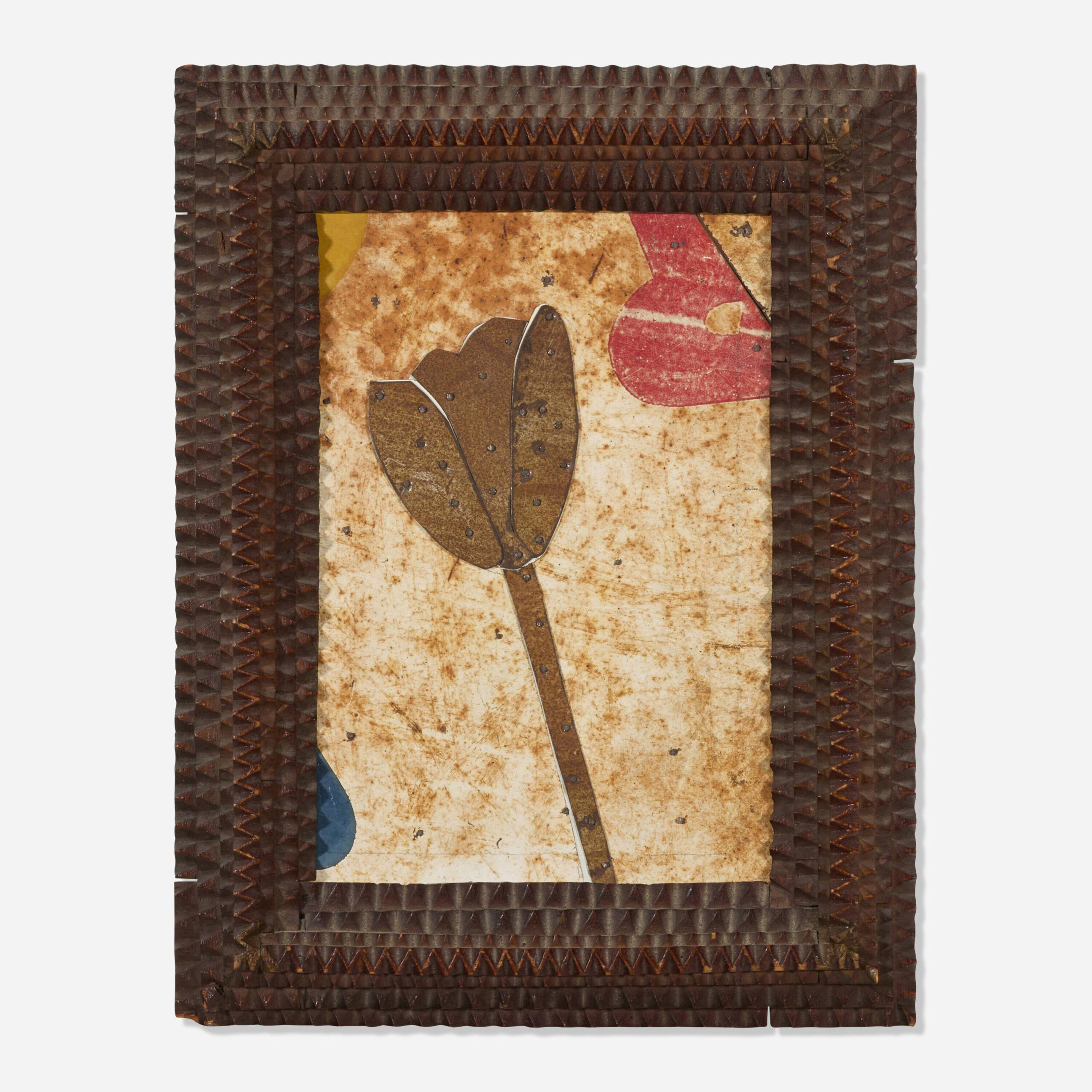
Dutch Tulip, 1979, found metal collage with steel brads on wood in found 19th century frame, 31 x 24 x 3 cm
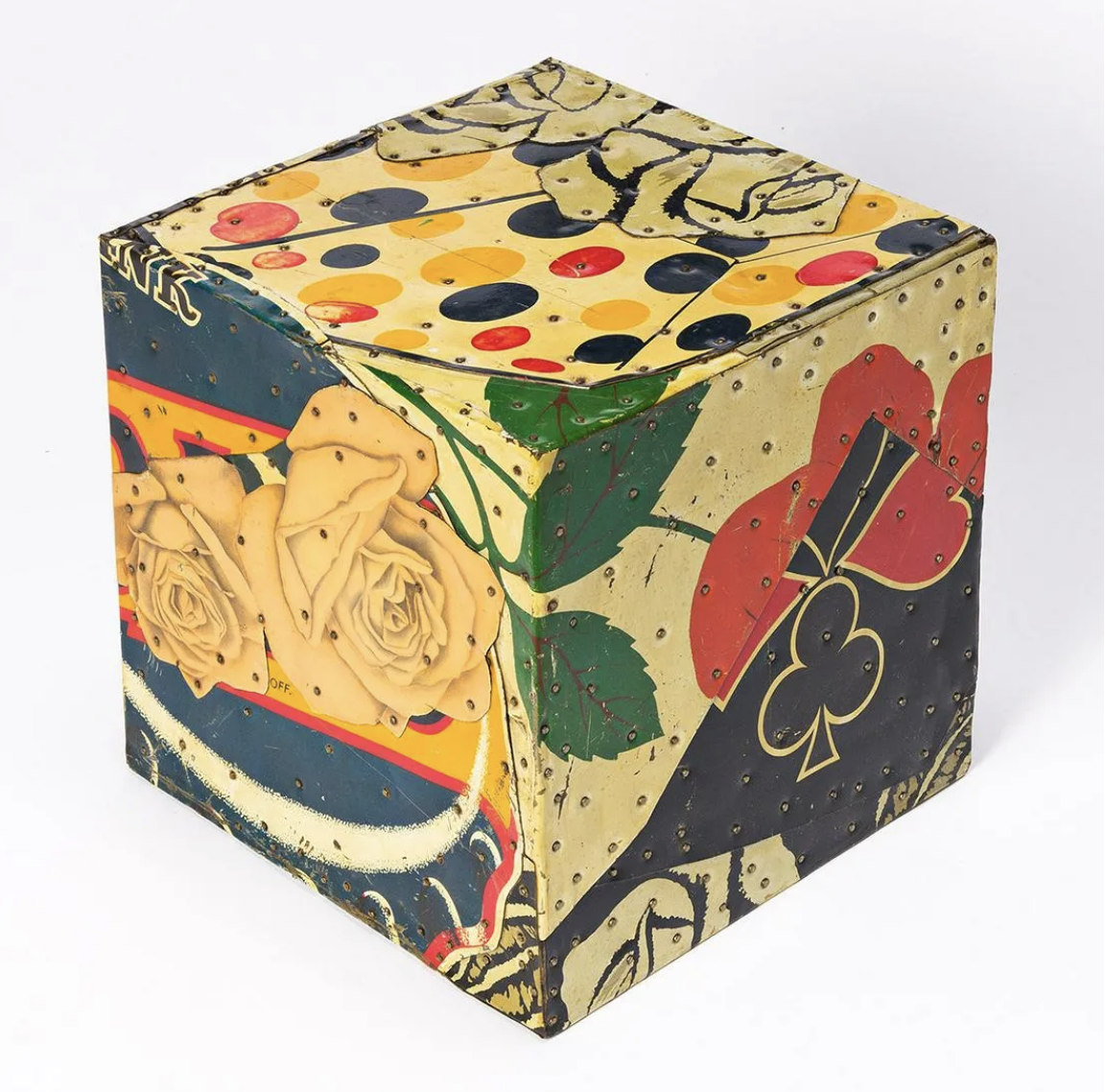
Untitled (Cube), c. 1965, found metal collage on wood with steel brads, 20 x 20 x 20 cm

August 7, 1958, Dizzy Dames, #70, 1991, found metal collage with steel brads on wood, 48 x 119 x 3 cm
