

PETER DREHER
THE OBSESSION OF TRANSPARENCY
An unexpected idea can emerge in the most unanticipated places, even in the warm water of a bathtub on a spring afternoon in April 1974. After years of carrying a thought that slept and woke with him every morning, the German artist Peter Dreher (1932-2020) experienced a sudden short circuit where every artistic deliberation flowed together into a single, crystal-clear decision. What began as a modest trial to paint a simple glass beaker five or six times to test a visual hypothesis transformed into an infinite, lifelong exploration lasting over forty years and yielding more than 5,200 individual paintings. By placing an ordinary, mass-produced laboratory beaker on a table in his studio, painting it at a strict 1:1 scale under identical conditions, Dreher initiated one of the most radical meditations on human perception in modern art. The project was never a mere technical exercise, but a portal into how we perceive reality, measure time, and inhabit the present moment.

THE ARTIST AS SCIENTIST AND THE REFUSAL OF EGO
During the 1970s, the European art world was saturated with the emotional intensity of Expressionism and Neo-Expressionism. Dreher found himself surrounded by this movement; his own teacher, Erich Heckel, had been a founding member of the historic Brücke group, while his contemporaries Georg Baselitz and Markus Lüpertz championed a passionate, subjective gesture on canvas. Realizing that this dramatic projection of personal angst did not suit his vision, Dreher sought to formulate a radically distinct point of view. He decided to strip his own ego entirely from the creative process, deliberately eliminating symbolic meanings, psychological expression, and artistic manipulation.
To achieve this neutral stance, Dreher positioned himself much like a scientist or a chemist setting up a controlled laboratory experiment. He placed the transparent glass beaker dead center on a plain surface at an equal distance from all borders, painting it in its exact original dimensions with a strictly reduced palette. Rather than treating the canvas as a stage for self-expression, he viewed himself merely as a receptive instrument, setting initial physical parameters without attempting to dictate or predict how the visual experiment would unfold.
THE PHYSICS OF LIGHT AND THE INSULAR EYE
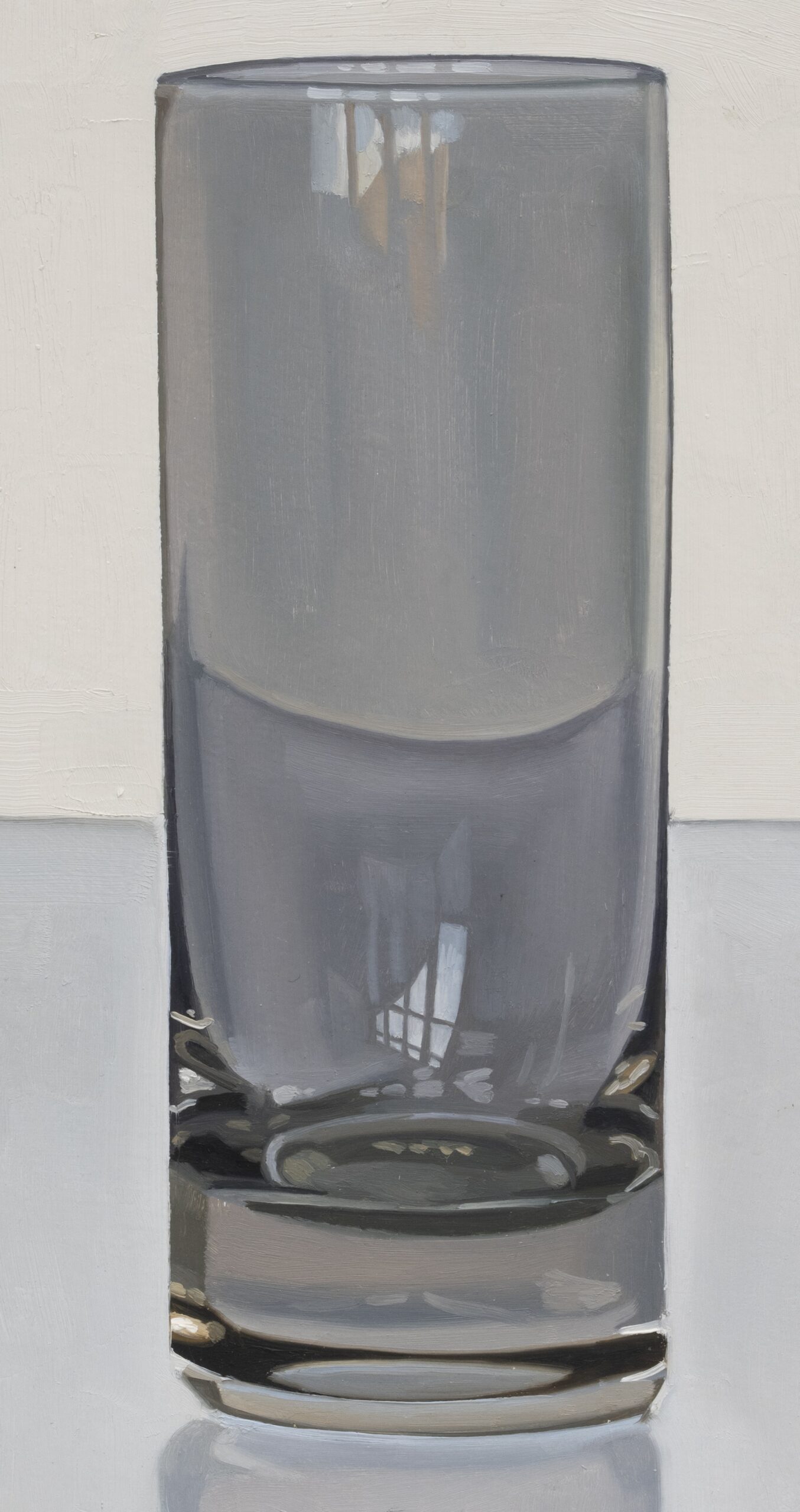
Working within these rigid parameters quickly revealed subtle optical phenomena that challenged the boundary between what an observer sees and what they intellectually know. Over the course of several hundred canvases, Dreher noticed that the white background behind the glass would gradually darken across successive paintings, only to brighten again later. Upon measuring this phenomenon scientifically, he realized that because the background wall receded at a slanted angle from his artificial light source, the intensity of the light naturally decayed over distance. Much like holding a sheet of white paper directly under a lamp and watching it darken as it is pulled away, the subtle shift in illumination was an objective physical reality captured by his neutral eye.
Beyond the physics of light, the project illuminated the biological nature of visual perception itself. Dreher realized that despite the illusion that human vision captures a seamless, continuous image, our eyes actually scan the world through rapid, jumping movements. Scientific studies of ocular tracking demonstrate how the eye incessantly leaps across an object, gathering information in isolated patches. Dreher referred to these focused visual points as “islands”. A finished painting, composed of thousands of individual brushstrokes and mini-emotions integrated layer by layer, directly mirrors this biological process, reconstructing a unified reality out of countless discrete moments of seeing.
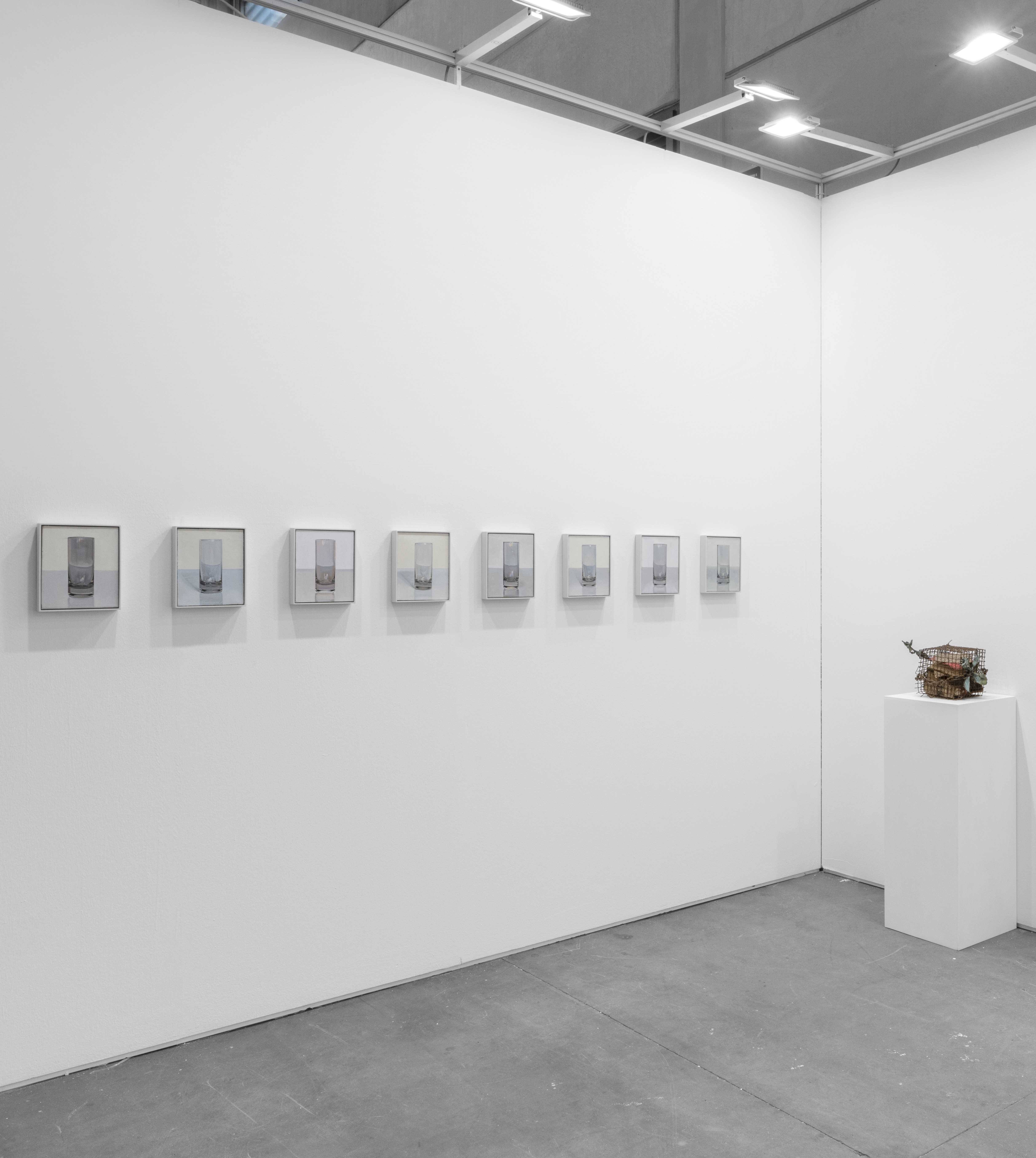
“I found out that I paint ‘islands’… Such insights in turn lead to very fundamental considerations, for example, that our vision is insular as well. When seeing something, we seem to perceive things in a continuous image. In truth, however, our eyes quickly scan the motif in front of us.” — Peter Dreher
«I paint, therefore I am.»
ATMOSPHERIC SHIFTS, NATURAL LIGHT, AND OTHER VESSELS
While the original series was executed under fixed artificial light in his studio in Sankt Märgen, Dreher eventually introduced a complementary series painted strictly in daylight. In this natural light series, the reflective glass cylinder no longer captured a single static bulb, but instead mirrored the cross-shaped frame of the studio window and the changing skies outside. As daylight slid across the studio throughout the afternoon, the subtle shifts in illumination expanded his tonal range, turning each canvas into a delicate register of atmospheric time.
This same disciplined, neutral approach was occasionally extended to other objects, demonstrating that Dreher’s method was a philosophy of vision rather than a preoccupation with a single subject. When he painted human skulls, he rendered them with the same weightless transparency as his glassware, stripping them of traditional macabre symbolism or sentimental grief. Similarly, when painting fresh flowers purchased at the Freiburg market or artificial paper flowers in his studio, he celebrated the pure visual pleasure of surface, light, and form, proving that a painted surface requires no grand narrative justification to hold profound artistic value.
“I reasoned that the background — the white wall behind the glass — was moving away from the glass and from me at a slanted angle, so that the intensity of the light faded gradually. I measured this just like a scientist examining optical phenomena.” — Peter Dreher
“Seeing with my own two eyes.”
THE PHILOSOPHY OF REPETITION
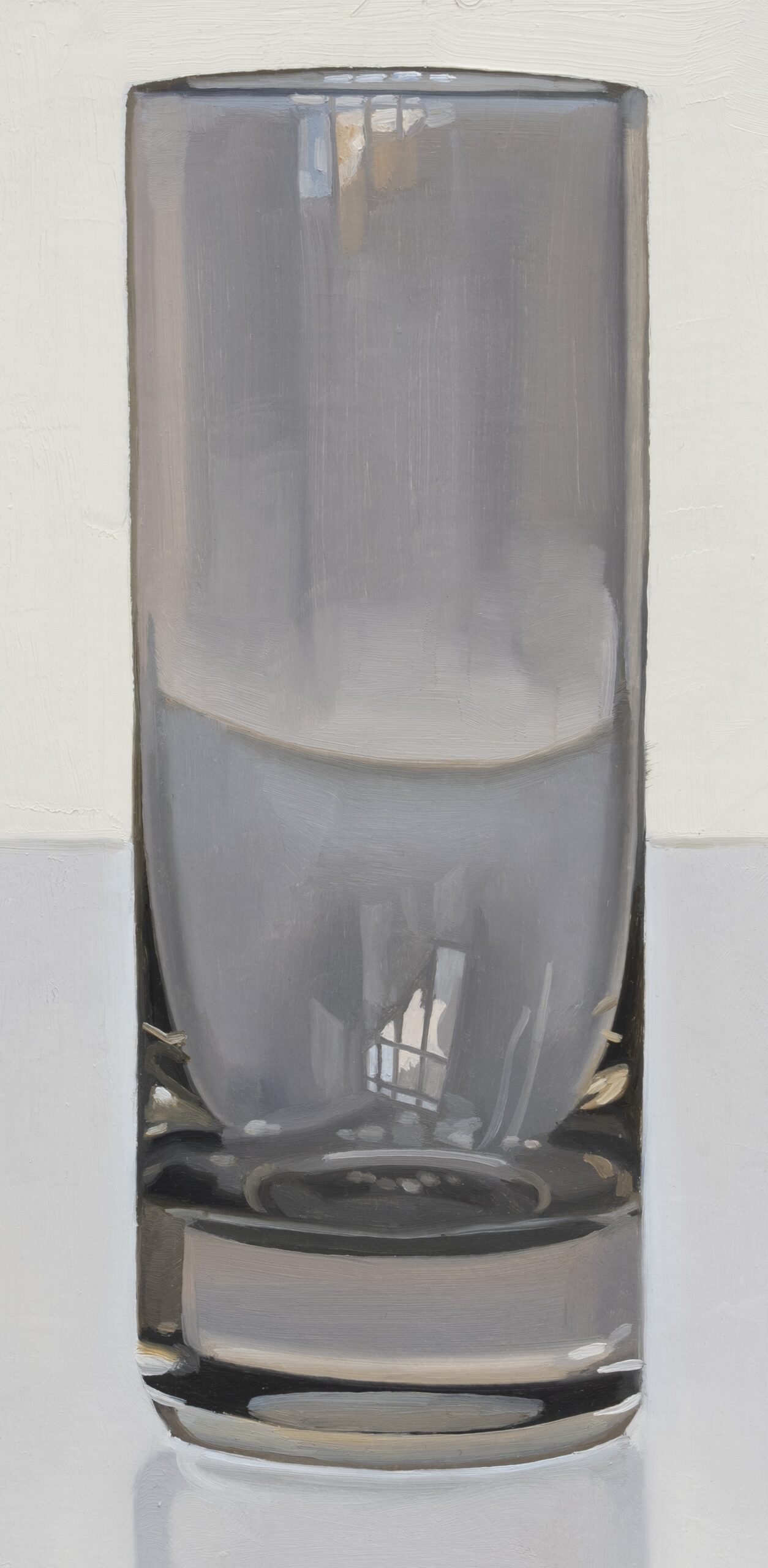
To observe an artist paint the same beaker thousands of times might suggest a mechanical routine, yet Dreher’s practice was the exact opposite of blind automation. Mechanical repetition is unseeing, whereas his daily ritual functioned as a continuous exercise in heightened alertness and open-mindedness. Because human attention and ambient conditions are never static, no two paintings in the series are identical; the differences between canvases occur spontaneously as a natural record of shifting perception.
This quiet discipline aligns closely with classic philosophical traditions. In The Book of Disquiet, Fernando Pessoa observed that a person relying purely on their senses could enjoy the entire spectacle of the world without ever leaving their chair. Dreher embodied this principle, exploring the infinite depth of existence by remaining seated before a single glass. Furthermore, his practice reflects the ancient phrase from Chan Buddhism, “Day by Day is a Good Day” (Tag um Tag ist guter Tag), capturing a calm, non-judgmental acceptance of time. Operating in a serene tonal palette of subtle grays reminiscent of Giorgio Morandi, Dreher integrated his daily painting task alongside simple meals, cups of white coffee, and the background rhythms of Baroque music by Domenico Scarlatti or modern minimal music.
“[It is] stroke by stroke, thousands and tens of thousands and millions of individual actions. And in my opinion, this combination of individual ‘mini emotions’ is something that is very specific to fine arts, very specific to the required craftsmanship, in particular when creating pictures by painting.” — Peter Dreher
“I PAINT, THEREFORE I AM” – IN PRAISE OF PURE PRESENCE
Each glass painting was completed within a single day, serving as a visual diary entry that preserved a precise fragment of human lifetime. In an era dominated by rapid media and a compulsive demand for artistic commentary, Dreher’s silent beakers offer a quiet resistance. They refuse to serve as allegories or hidden metaphors, embodying what literary critic George Steiner described as the weight of “real presence”—a tangible reality that simply exists without needing external explanation.
This refusal of forced symbolism connects directly to Susan Sontag’s famous thesis in Against Interpretation, which called for recovering our immediate sensory experience of art rather than replacing objects with intellectual theories. When asked about his ultimate artistic intention, Dreher offered a remarkably simple answer: “Seeing with my own two eyes“. By dedicating his life to capturing the immediate, untranslatable reality of what lay before him, Dreher transformed the Cartesian axiom of self-awareness into an artist’s creed: “I paint, therefore I am“.
The historical details, direct quotes, and personal reflections in this article are drawn directly from Peter Dreher’s text ‘The Glass Series’, published in Peter Dreher – Pearl Series and Silver Bowls (2014). Additional critical and philosophical insights are based on Volker Bauermeister’s essay ‘Essay without words’ and notes by Hans Albert Peters.
