The strength of a painting lies in its presence, its ability to stand on its own, without explanation or excuse.
— Ludwig Sander
The strength of a painting lies in its presence, its ability to stand on its own, without explanation or excuse.
— Ludwig Sander
Biography
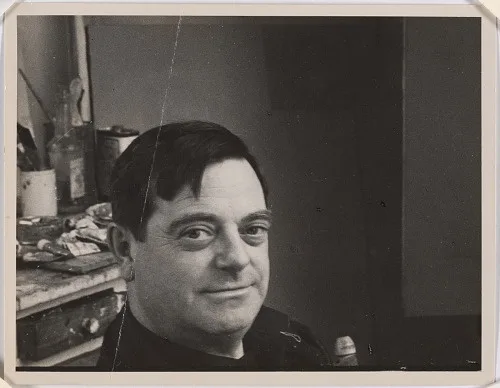
Ludwig Sander, the son of a musician, was born on Staten Island on July 18, 1906. He left New York University in 1926 to dedicate himself to painting, following an early exposure to European and German art styles. After studies at the Art Students League (1928–1930), a pivotal point in his artistic development was his time spent studying with Hans Hoffman in Munich (1931–1932), a move encouraged by Vaclav Vytlacil. Hoffman influenced Sander to abandon previously acquired ideas about figure and landscape drawing.
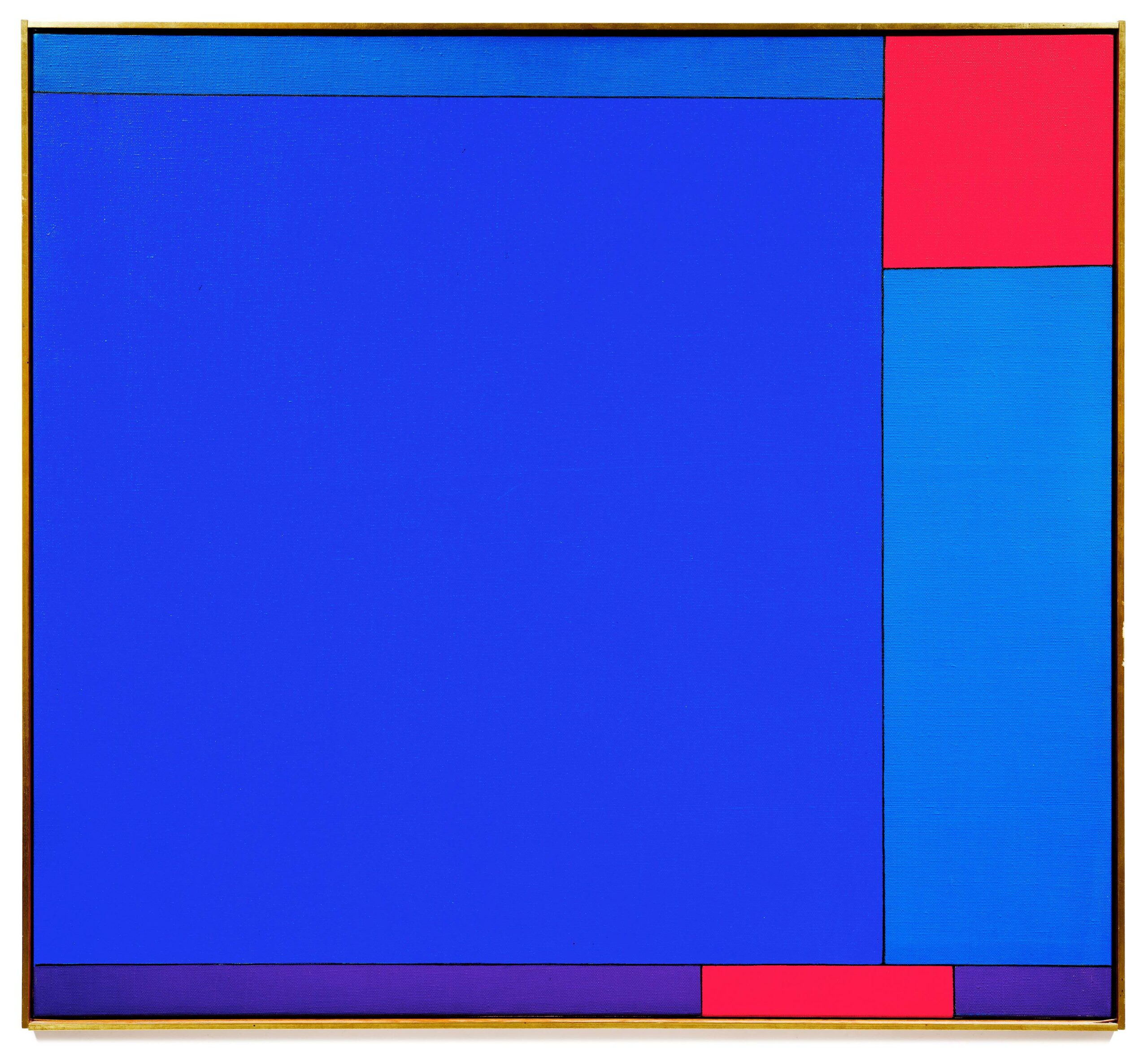
Upon returning to New York, Sander initially worked in a referential abstract style, but he later became widely known for his geometric work. His mature style, evident by the early 1950s in works such as Untitled Blue Abstract (1952), established him as an abstract painter pursuing a unique aesthetic—a hybrid of Color Field painting, positioning him stylistically between hard-edge painters and those focused on post-painterly abstraction.
Sander was also active as a teacher at institutions like the Art Students League and Bard College, having been encouraged by Vytlacil, whom he considered “a born teacher.” In the latter part of his career, Sander received significant professional recognition, including a John Simon Guggenheim Foundation Fellowship in 1968 and election as a member of the National Institute of Arts and Letters in 1971. His work was exhibited internationally—including the Venice Biennale and “Post-Painterly Abstraction” exhibition—and is held in the collections of major institutions, such as the Metropolitan Museum of Art, the Whitney Museum of American Art, and the Solomon R. Guggenheim Museum.