

GENE DAVIS
THE GEOMETRY OF PERCEPTION
Tracing a vertical line across a blank surface is fundamentally an act of marking space, yet in the hands of American artist Gene Davis, it transformed into a profound exploration of human consciousness. For Davis, the vertical stripe was not merely a decorative motif, but his essential “subject matter”. Drawing inspiration from Paul Klee’s famous description of doodling as “taking a walk with a line” and Barnett Newman’s discretely divided fields, Davis took the spontaneous linear doodle and systematized it into a pure, non-illusionistic pictorial field. By organizing his compositions around a repeating sequence of vertical stripes, Davis executed what he termed a “spatial abstraction of time”. In his artistic vision, the traditional opposition between the lawfulness of geometric form and the untamed atmospheric quality of color dissolves into a single, unified experience. What emerges across Davis’s body of work is a meditative visual architecture where spatial intervals mirror temporal duration, inviting the observer on an extended journey into the nature of perception itself.

Gene Davis, Red+Green, acrylic on canvas, 31 x 41 cm

Detail of the signature
THE GEOMETRY OF ATMOSPHERE: GENE DAVIS’S SYNTHESIS OF ORDER AND UNCONTROLLABLE COLOR
The core of Gene Davis’s artistic breakthrough lies in his dialectical integration of geometry and atmospheric intensity. Davis embraced what he called an “improvisational” and “renegade” approach to color selection, deliberately choosing unexpected hues to maximize atmospheric impact. In doing so, Davis explicitly rejected Josef Albers’s a priori formal rules of color interaction, as well as the narrow modernism of Clement Greenbergian critics who sought to contain color energy within simple, static shapes. To Davis, raw color was an uncontrollable, almost chaotic stimulus—an expression of libidinous intensity that resisted easy verbal translation.
Rather than allowing this emotional intensity to descend into disorder, Davis utilized the strict rectitude and uncompromising repetition of the vertical stripe to ground and bind the color. Line and color—control and atmosphere—do not merely exist side by side in Davis’s work; they directly coincide in a single, determinate structure. The geometric grid of stripes acts as a stabilizing harness, neutralizing potential chaos while preserving the full, vibrant freedom of the color itself. Through this unique formalism, Davis demonstrated that rigorous geometric order could serve as the ultimate vessel for raw emotional experience.
THE SPATIALIZATION OF DURATION: BERGSONIAN TIME IN DAVIS’S STRIPE FIELDS
In a pivotal 1975 conversation with architect Donald Wall, Gene Davis remarked that critics often missed the temporal element of his work, emphasizing that his stripe paintings represent “a spatial abstraction of time”. Davis understood that his compositions could never be comprehended in a single, instantaneous glance. Channeling a principle reminiscent of Hegelian philosophy, Davis noted that a color achieves its identity only through juxtaposition and difference. Each individual color-stripe possesses an immediate, localized presence, yet its contrast with neighboring stripes creates a spatiotemporal ripple effect that resonates across space and vibrates over time.
This structural organization closely parallels Henri Bergson’s philosophical distinction between conceptualized time and true inner duration. According to Bergson, measuring time through spatial units merely counts external simultaneities, like tracking the oscillations of a pendulum. True duration, by contrast, involves the continuous interpenetration of conscious states. In Davis’s paintings, the modular repetition of the stripes provides the spatialized framework of succession, while the subtle differentiation of color allows the viewer to experience fluid, qualitative duration. The canvas becomes a living medium where time itself unfolds as an internal rhythm.
“The time element in my work has been missed by most critics. That is, the analogy between dividing up two-dimensional space and dividing up time. It’s almost as if I were, in my stripe paintings, doing an abstraction of time—a spatial abstraction of time.” — Gene Davis, interview with Donald Wall (1975)
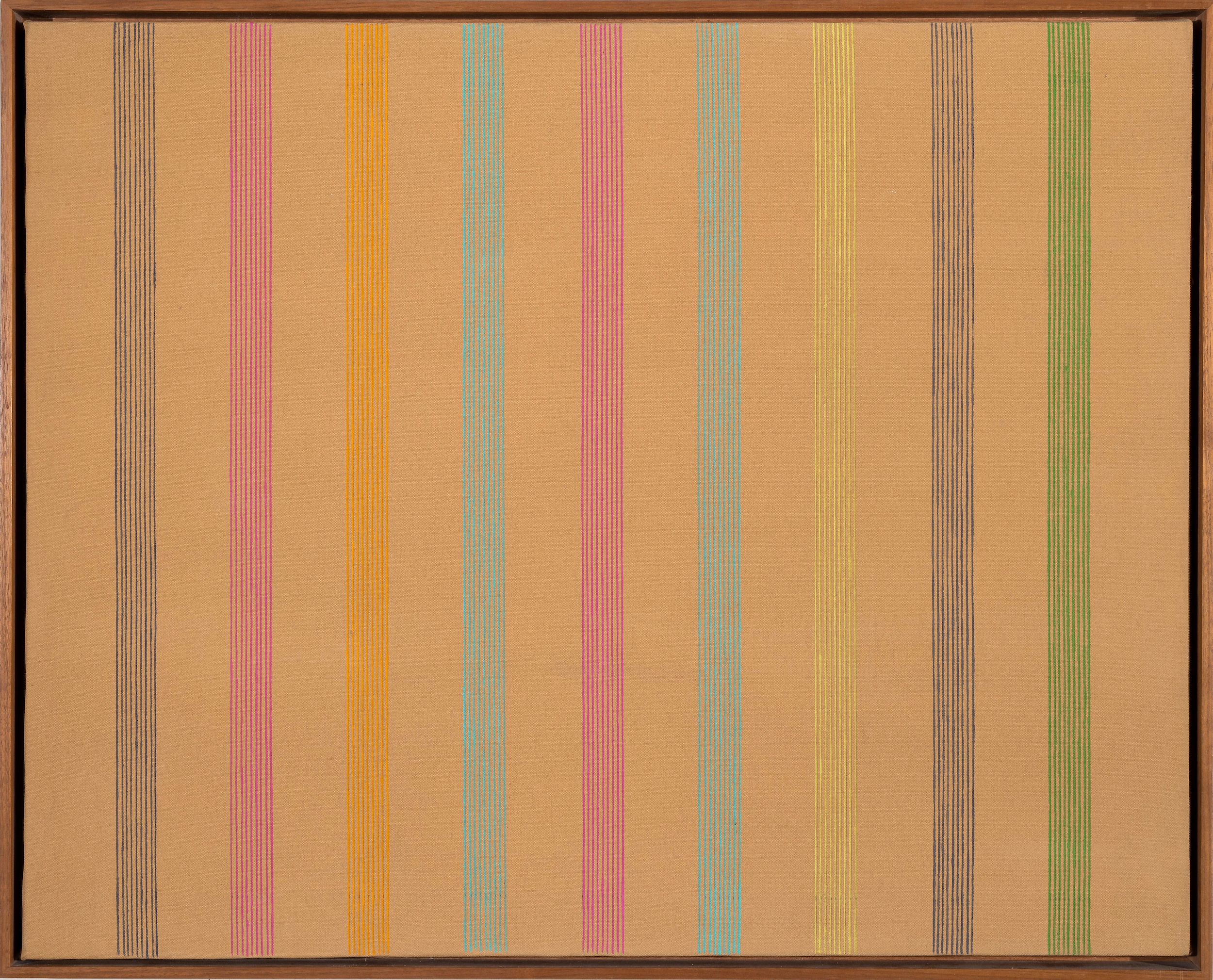
Gene Davis, Untitled, 1970, acrylic on canvas, 61 x 76 cm
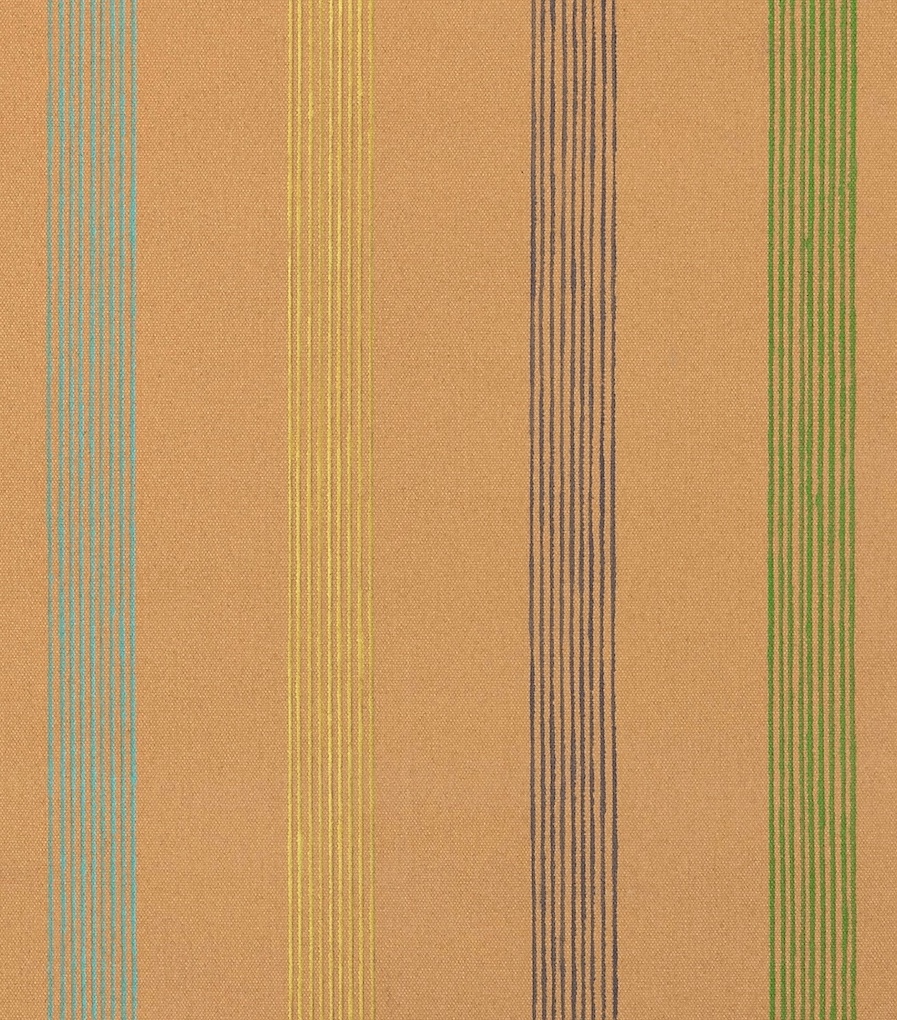
Detail
“I became convinced that the way to make really good art was to do the outrageous, the unexpected—to be a renegade.” — Gene Davis
VISUAL MUSIC AND EGO-MASTERY
Gene Davis frequently compared his stripe paintings to non-objective music, noting that both mediums share a primary preoccupation with intervals—music organizing temporal intervals, and painting organizing spatial intervals. This musical analogy carries a profound psychological significance. Drawing on psychoanalytic theory regarding the perception of nonverbal stimuli, encountering an overwhelming influx of unorganized sensory data challenges the human ego and mobilizes inner energy to withstand anticipated anxiety.
Davis’s stripe paintings confront the observer with a near-chaotic influx of vibrant color stimuli, yet they simultaneously provide immediate reassurance through the elementary intelligibility of the stripe format. The rigid, uncompromising law of the stripe functions as a mechanism for ego-mastery, binding and neutralizing disruptive emotional energy. Davis spoke candidly of an inherent “schizoid” tension within his own personality, which manifested in compositions split down the middle or divided into disjunctive fields. By bringing these internal conflicts under the rational containment of the linear grid, Davis’s art offers a therapeutic act of ego integration, turning emotional chaos into an experience of profound, harmonious control.

Gene Davis, Lemon Juicer, 1958, acrylic on canvas, 36 x 46 cm
“My whole approach is intuitive. Sometimes I simply use the color I have the most of and worry about getting out of trouble later.” — Gene Davis
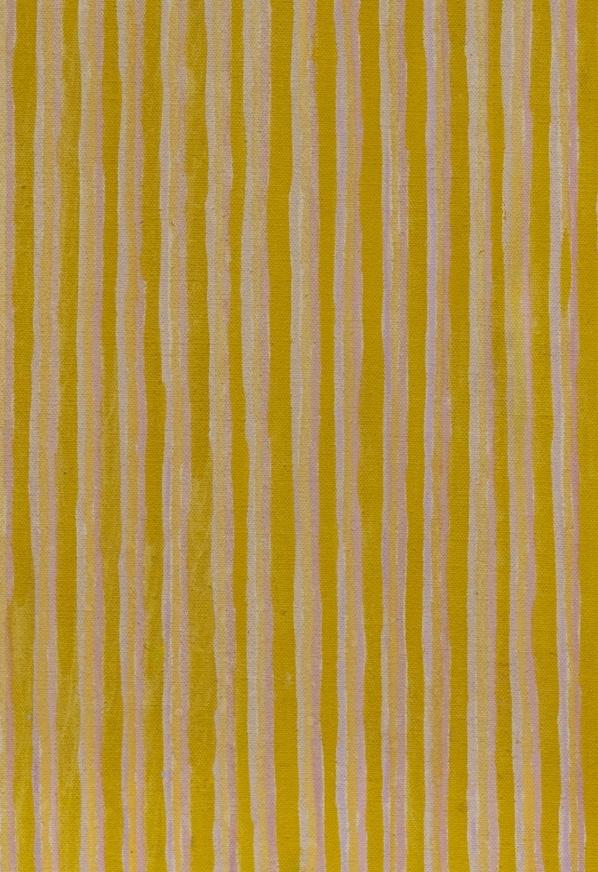
detail, Lemon Juicer, 1958
THE DYNAMIC FIELD: MOTOR-PROGRESSIVE VECTORS AND PERPETUAL FLUX
Far from presenting a static or monotonous grid, Gene Davis conceived his vertical stripes as “motor-progressive” vectors designed to propel the viewer’s eye across the pictorial surface. The apparent velocity of this visual journey fluctuates dynamically based on stripe width, spatial intervals, and color contrast. Davis deliberately avoided settled, predictable formulas, pursuing a “zigzag” evolutionary path that explored an inexhaustible variety of stripe configurations.
Davis manipulated the spatial intervals between stripes to generate a wide spectrum of visual tension. In his “spaceless” compositions, stripes are tightly packed with no intervening gaps; in his “centerless” or “spacey” works, clusters of stripes are isolated at opposite ends of the canvas. This constant manipulation keeps any given format in an indeterminate state—seemingly on the verge of mutating or re-inventing itself. As the viewer roams across the field, the disjunctions and conjunctions between color bands create a primitive, hypnotic rhythm, alternating between intense stimulation and restful pauses. The result is an eternal present of transition, where static geometry transforms into an epiphanic, shifting visual cadence.
EXPANDING THE BOUNDS: FROM MICRO-PAINTINGS TO ARCHITECTUAL SCALE
Gene Davis’s radical reinterpretation of the stripe format allowed him to play with scale like an accordion, ranging from intimate micro-paintings to monumental public installations. In his early development, Davis transformed the aggressive, smoldering gestures of Abstract Expressionism into regularized, congealed vertical stripes. Staining pigment directly into the canvas fibers, he eliminated illusionistic depth, allowing the vertical stripe to function as an extended, contained gesture dropping perpendicularly from a sublime height.
By expanding his stripe fields beyond the traditional boundaries of the easel painting, Davis directly engaged with architectural space. In his monumental installations—including massive street paintings and public gallery interventions—Davis bypassed the organic human figure as the traditional benchmark for artistic scale. Following the radical trajectories of early abstractionists like Kasimir Malevich and Piet Mondrian, Davis replaced figural representation with an eternal, non-illusionistic geometry. The repeating vertical stripes wrap around the surrounding environment, generating an expansive aura that blurs the line between the painted surface and physical architecture.
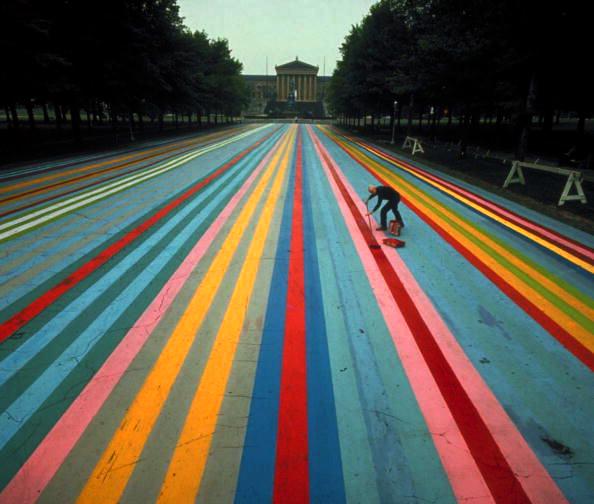
Gene Davis, Franklin’s Footpath, 1972, Philadelphia Museum of Art
THE DOUBLE SUBLIME: RECONCILING THE INSTANT AND THE INFINITE IN DAVIS’S LEGACY
Gene Davis’s radical reinterpretation of the stripe format allowed him to play with scale like an accordion, ranging from intimate micro-paintings to monumental public installations. In his early development, Davis transformed the aggressive, smoldering gestures of Abstract Expressionism into regularized, congealed vertical stripes. Staining pigment directly into the canvas fibers, he eliminated illusionistic depth, allowing the vertical stripe to function as an extended, contained gesture dropping perpendicularly from a sublime height.
By expanding his stripe fields beyond the traditional boundaries of the easel painting, Davis directly engaged with architectural space. In his monumental installations—including massive street paintings and public gallery interventions—Davis bypassed the organic human figure as the traditional benchmark for artistic scale. Following the radical trajectories of early abstractionists like Kasimir Malevich and Piet Mondrian, Davis replaced figural representation with an eternal, non-illusionistic geometry. The repeating vertical stripes wrap around the surrounding environment, generating an expansive aura that blurs the line between the painted surface and physical architecture.
The information presented in this article is based primarily on the exhibition catalogue Gene Davis: A Memorial Exhibition, published by the Smithsonian Institution Press for the National Museum of American Art on the occasion of the exhibition held from 27 February to 17 May 1987. Quotations by Gene Davis have been sourced from materials held by the Smithsonian Archives of American Art.
