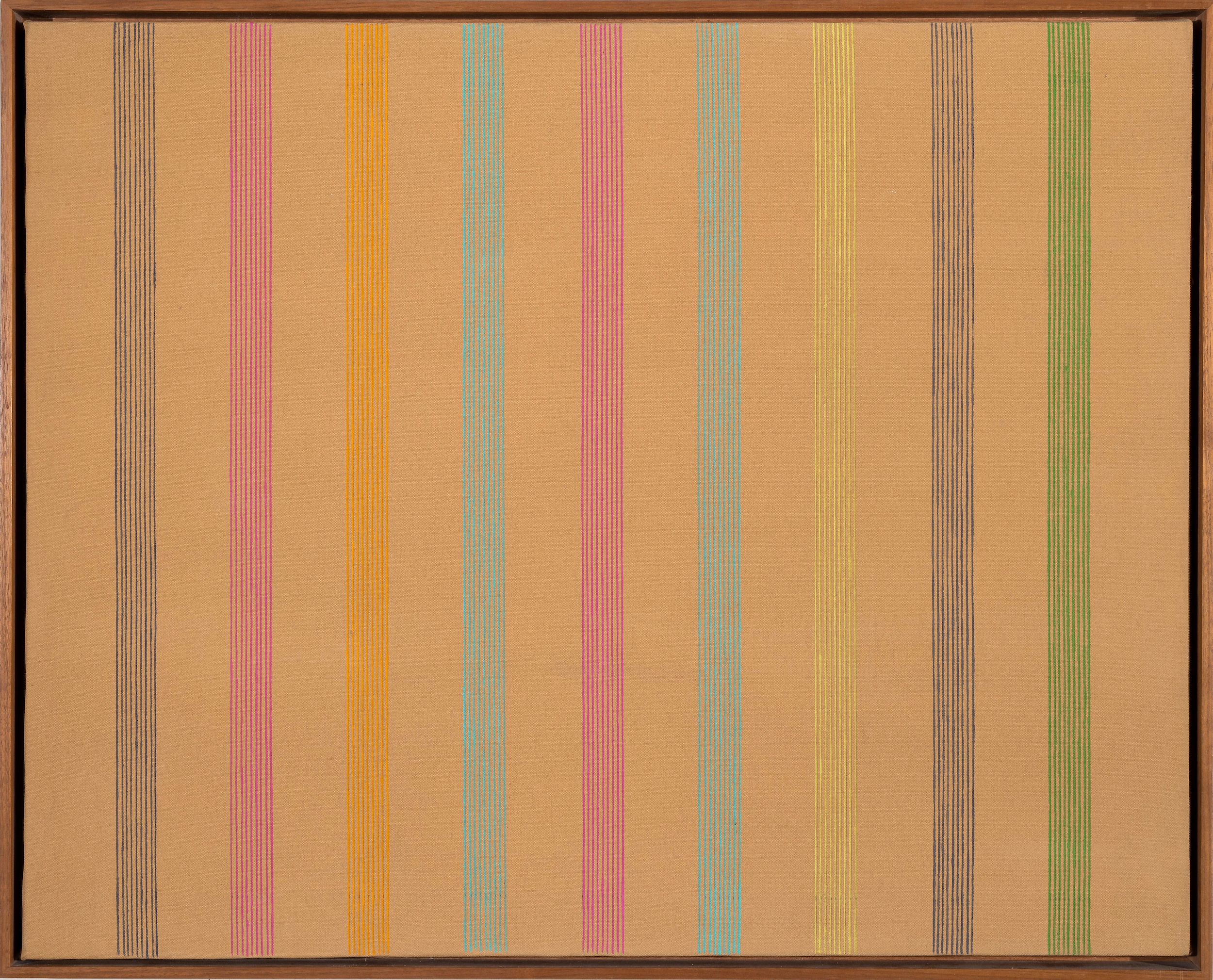
My whole approach is intuitive. Sometimes I simply use the color I have the most of and worry about getting out of trouble later.
— Gene Davis
My whole approach is intuitive. Sometimes I simply use the color I have the most of and worry about getting out of trouble later.
— Gene Davis
Biography
Gene Davis’s distinctive artistic journey is characterized by his unique self-education, his improvisational working method, and his specific theoretical focus on “color interval” within his signature stripe paintings.
Born in 1920 in Washington, D.C., Gene Davis initially pursued careers as a sportswriter and a White House correspondent before moving into art. Crucially, Davis was never formally trained. Instead, he educated himself through assiduous visits to museums and galleries in New York and Washington, paying particular attention to institutions like the Phillips Collection. He also benefited from the guidance provided by his friend, artist and curator Jacob Kainen.
Davis considered his nonacademic background a “blessing” that liberated him from the constraints and limitations often imposed by a traditional art school orientation.
Davis’s approach is marked by a strong preference for spontaneity and a distinct improvisational quality. This quality was present in his early paintings and drawings—even those showing the influence of figures like Paul Klee and Arshile Gorky—and persisted into the color selection for his later stripe works.
In keeping with his “unorthodox attitudes,” Davis’s works do not progress in an orderly, linear sequence. His working method was characterized by “a tendency to raid my past without guilt”. He would return to ideas he had “flirted with briefly, say fifteen or twenty years ago,” and explore them more deeply, “almost as if no time had elapsed” since their original conception. This method results in similar works often being separated by years or even decades. His output reveals a seriousness balanced by whimsy, reflecting his romantic, “free-wheeling approach to art-making”.
In the 1960s, art critics recognized Davis as a leader of the Washington Color School. This loose association of Washington painters focused on creating abstract compositions in acrylic colors on unprimed canvas, championing what critic Barbara Rose called the “primacy of color”.
However, Davis’s artistic goal differed significantly from that of other Color School artists, such as Morris Louis and Kenneth Noland. Louis and Noland generally favored “oneshot” compositions—symmetrical images that were intended to be instantly comprehended at a glance.
In sharp contrast, Davis focused on complex schemes designed for sustained periods of viewing. When discussing his stripe work (which in the 1960s often consisted of hard-edged, equal-width stripes), Davis emphasized the concept of “color interval,” rather than just the importance of color. Color interval refers to the “rhythmic, almost musical, effects” resulting from the irregular appearance of specific colors or shades within the composition.
Davis instructed viewers to move beyond a simple glance. He encouraged them to “select a specific color—and take the time to see how it operates across the painting”. He stated, “Enter the painting through the door of a single color, and then you can understand what my painting is all about”.
Although best known for his stripe works, which span twenty-seven years, Davis was a versatile artist who worked across a wide variety of formats and media.
In 1966 Davis began teaching at the Corcoran School of Art, where he became a permanent member of the faculty. His works are present in the collections of, among others, the Corcoran Gallery of Art, the Solomon R. Guggenheim Museum, The Phillips Collection in Washington D.C., the Pérez Art Museum Miami in Florida, the Walker Art Center in Minneapolis, Minnesota, The Governor Nelson A. Rockefeller Empire State Plaza Art Collection in Albany, New York, and the Smithsonian American Art Museum.
Gene Davis died in April of 1985 in Washington, D.C.

Gene Davis – photo by Rosalind Solomon