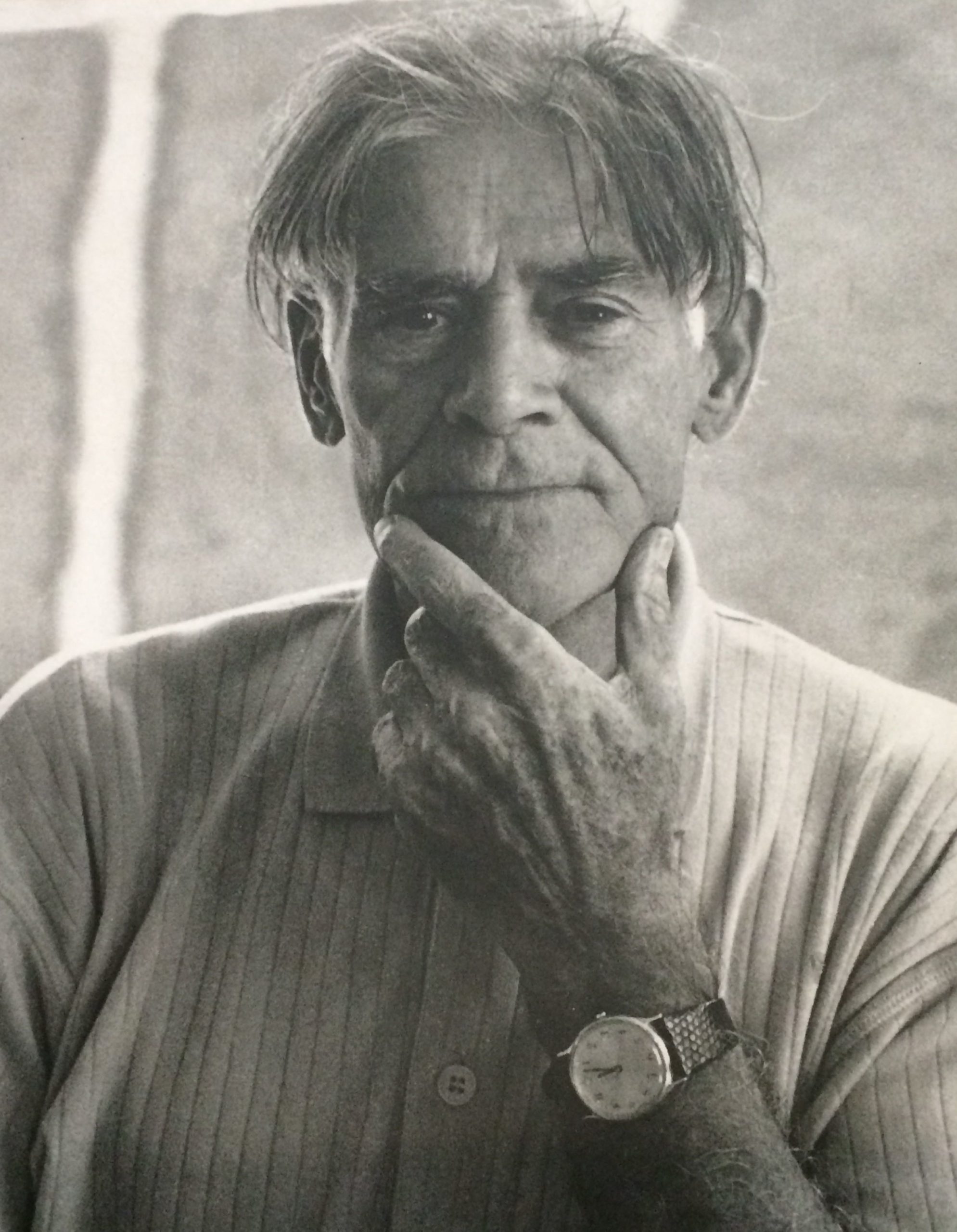
My work is a dialogue between form and space, a search for simplicity and harmony in the human environment.
— Costantino Nivola
My work is a dialogue between form and space, a search for simplicity and harmony in the human environment.
— Costantino Nivola
Biography
Costantino Nivola was born in Orani, Sardinia, on July 6, 1911, the fifth of ten children of a mason. After elementary school, he worked alongside his father and brothers as a laborer. In 1926, he left Orani to apprentice with the painter Mario Delitala in Sassari. He presented his watercolor La collina and two other works at the First Sindacale Exhibition in Sassari in 1930.
In 1931, Nivola enrolled at the Istituto Superiore per le Industrie Artistiche (ISIA) in Monza, thanks to a modest scholarship. While there, he befriended fellow Sardinian scholarship recipients Salvatore Fancello and Giovanni Pintori. In 1933, he switched from the Pictorial Decoration section to the newly established Graphic Advertising section. His teachers included Edoardo Persico, Marcello Nizzoli, and Giuseppe Pagano. Nivola held his first solo show in Sassari in 1933, where, despite selling nothing, the entire exhibition was purchased by Count Ticca. In 1934, he was suspended from ISIA for six months for refusing to give the Fascist salute, although the intervention of Ticca blocked an attempt to expel him. While at ISIA, he met Ruth Guggenheim, a young German Jew who was also a student.
After graduating from ISIA in 1935, Nivola moved to Milan. Through Pagano and friends of Adriano Olivetti (the Guggenheims), he was hired as a graphic designer at the Olivetti Development and Advertising Office in Milan in 1936. He soon became the artistic director of the graphic section in 1937. Pagano also involved Nivola in the setups of major exhibitions, including the Sixth Milan Triennial (1936) and the Italian Pavilion at the Paris International Exposition (1937). The sight of the Spanish Republican Pavilion in Paris contributed to the maturation of his anti-fascist sentiments.
In New York, Nivola worked as an art director for magazines like Interiors (starting 1940) and You (starting 1941). This work put him in contact with prominent figures in European architecture and design, such as Gropius and Breuer, and he became involved in the New York art scene, developing relationships with artists including De Kooning, Kline, Léger, Pollock, and Saul Steinberg. He and Steinberg had a joint exhibition in 1943. In 1946, Nivola met Le Corbusier, became his friend, and the two shared a studio for four years.
Around 1948–1949, Nivola bought a house in Springs, near East Hampton. It was here, while playing with his children on the beach, that he invented the technique of sandcasting. This is a method used to create concrete sculptures from sand matrices. Nivola debuted as a sculptor in 1950. His international success was immediate following his first commission—a sandcasting panel for the Olivetti showroom in New York (1954). He quickly became one of the most recognized sculptors for architecture, contributing to the debate on the synthesis of the arts. That same year (1954), he became the director of the Design Workshop at Harvard University.
Nivola’s work focused on the major themes of the “mother” and the “builder,” community life, and art as a tool for civic growth and participation. He drew inspiration from popular tradition and the prehistoric art of Sardinia, revisiting these forms in modern ways.
His commitment to public art continued through the 1950s and 1960s, executing major works like the sculptures for the Morse and Ezra Stiles colleges at Yale University (1960–1961) and contributing to the decoration of the UNESCO headquarters in Paris (1955). In 1965–1966, he realized his first public work in Sardinia: a piazza dedicated to the poet Sebastiano Satta in Nuoro. While he continued his public commissions, starting in the 1960s he also created smaller, more intimate terracotta works. He later returned to marble and bronze, producing the solemn Mothers series (beginning 1974) that celebrated the generative power of women and nature.
Nivola taught at several prestigious institutions, including Columbia University, Harvard University, the University of Berkeley, and the Royal Academy of Fine Arts in The Hague.
Costantino Nivola died in Long Island on May 6, 1988.