

LUDWIG SANDER
THE QUIET MASTER OF AMERICAN ABSTRACTION
Ludwig Sander remains one of the most intriguing, yet quietly resolute, figures of twentieth-century American abstraction. While many of his Abstract Expressionist contemporaries embraced dramatic gestural angst, Sander forged a path defined by contemplative balance, subtle spatial tension, and luminous fields of color. His 1969 oral history interview with Paul Cummings for the Archives of American Art reveals a life deeply entwined with the cultural transformation of New York, European artistic discipline, wartime intelligence service, and the intimate circles of the post-war American avant-garde.
A NEW YORK UPBRINGING AND EARLY ECHOES OF ART
Born in New York City into a cultured family of German and French descent, Ludwig Sander grew up immersed in the city’s rich cultural rhythms long before art education became standardized in public schools. His parents, both passion-driven music lovers, frequently took young Ludwig to weekly opera performances at the Metropolitan Opera House and concerts at Carnegie Hall simply because subscription seats needed to be filled. During family visits across Manhattan, relative chaperones often escorted him to the Metropolitan Museum of Art or the Museum of Natural History to pass the time.
Sander’s visual curiosity awakened early through international art periodicals subscribed to by his father, including the Munich journal Jugend, which introduced him to Jugendstil and Impressionist compositions. As a young child, he recalled following an Impressionist painter named Charlie Bazing around Staten Island, fascinated as the artist painted miniature landscapes directly onto wooden cigar box lids attached to his easel. Though Sander initially pursued architecture courses at Columbia University and briefly attended New York University, his dissatisfaction with conventional academic tracks soon impelled him to commit entirely to the visual arts.
“At an age I can’t remember, I used to be taken to the Metropolitan to get me the hell out of the way.” — Ludwig Sander, interview with Paul Cummings (1969)
EUROPEAN ENCOUNTERS AND THE MUNICH STUDIO
In the late 1920s and early 1930s, driven by an eagerness to experience the European art scene firsthand, Sander traveled overseas. After brief studies with Alexander Archipenko in New York and summer excursions to the Woodstock art colony, Sander arrived in Munich in the autumn of 1931. There, he enrolled in the school of Hans Hofmann.
Sander’s period in Munich proved foundational, though distinct from the popular mythologies surrounding Hofmann’s later American teaching. The class was intimate—comprising a small, highly international group of dedicated students—and focused rigorously on charcoal drawing from live models. Rather than applying paint, students worked and reworked single charcoal drawings for an entire week, searching for a spatial synthesis that rendered three-dimensional reality in strictly two-dimensional terms. Following his time in Munich, Sander spent months painting in the ruined, picturesque village of Positano, Italy, before economic reverberations of the Great Depression forced him to return to New York in late 1932.
“We drew on charcoal paper… and we drew on that same drawing until we practically had holes in it. It was a matter of considering the paper a flat two-dimensional surface and our expression was two-dimensional with some grasp of the third dimension.” — Ludwig Sander, interview with Paul Cummings (1969)

“That’s the first time in my life I felt useful… It was real. You did something and there were results. It wasn’t just painting something—a picture over for the fifth time in a haphazard sort of way.” — Ludwig Sander, interview with Paul Cummings (1969)
WAR, INTELLIGENCE, AND FINDING PURPOSE
Returning to a Depression-era New York offered few commercial opportunities for abstract painters. Sander lived and worked in modest Greenwich Village studios—including legendary buildings on Third Street and Washington Square—painting diligently despite damaged canvases and minimal public recognition.
When the United States entered World War II, Sander enlisted and served over three years in the U.S. Army. After undergoing rigorous language and area training at Indiana University, he served in military intelligence at the regimental level along the German front line. Analyzing captured maps, conducting tactical interrogation, and tracking enemy troop movements provided Sander with a profound sense of concrete utility. He later reflected that breaking down tactical information to protect soldiers was the first time in his life he felt directly useful to humanity, contrasting the stark, decisive clarity of wartime intelligence with the open-ended ambiguity of the artist’s studio.
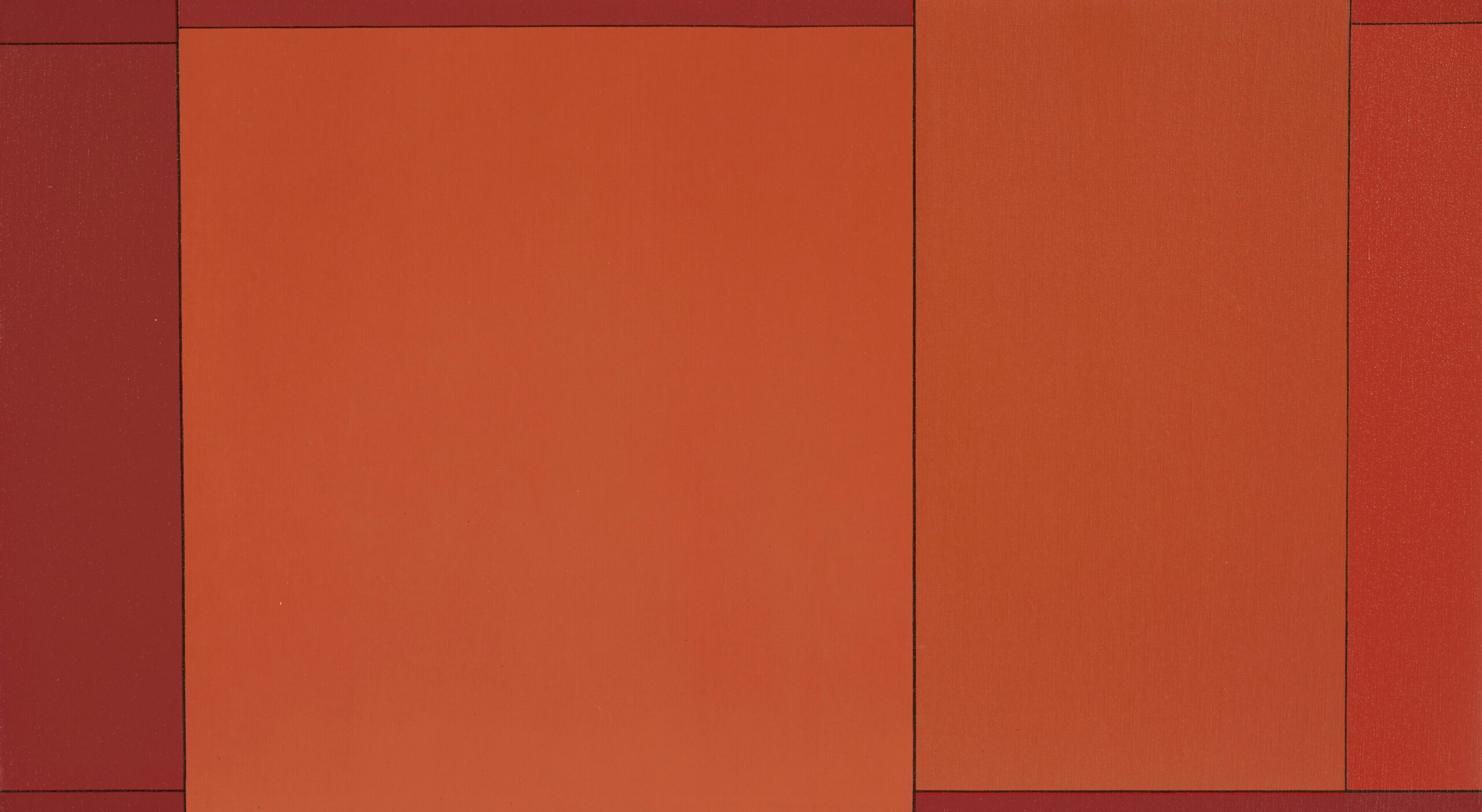
“In anything you do, you’ve got to do it beyond the point of where it can be explained… The excellence is somewhere beyond explanation.” — Ludwig Sander, interview with Paul Cummings (1969)
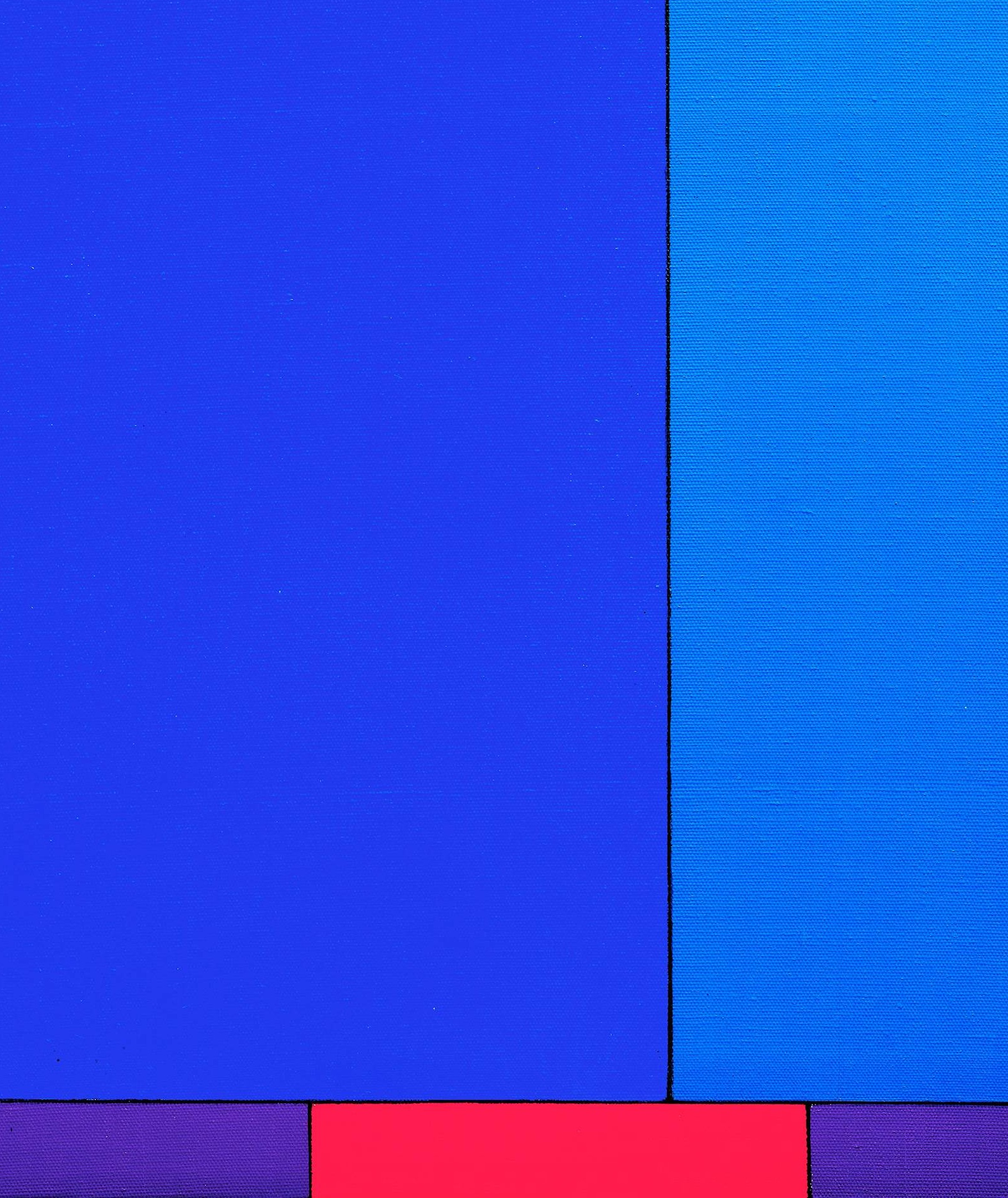
detail, PAWNEE IX, 1969
THE BIRTH OF “THE CLUB” AND THE NEW YORK VANGUARD
Upon returning to New York after the war, Sander re-entered a rapidly evolving Greenwich Village art community. Reconnecting with long-time friends like Willem de Kooning, Reuben Nakian, Franz Kline, and Conrad Marca-Relli, Sander became a key founding figure of “The Club” around 1949. Originally conceived as a modest, private sanctuary where artists could escape noisy cafeterias, drink coffee, and converse freely without formal manifestos or political agendas, The Club quickly grew into the vital intellectual hearth of Abstract Expressionism.
In 1951, Sander also played a central role in organizing the landmark Ninth Street Show alongside dealer Leo Castelli. Held in a vacant, cavernous wholesaler’s store on East Ninth Street, illuminated by a single 300-watt bulb extending from the second-floor flagpole, the exhibition drew overflowing crowds of artists, critics, and collectors, signaling the triumphant emergence of the New York School.
THE SUBTLE POWER OF COLOR AND LINE
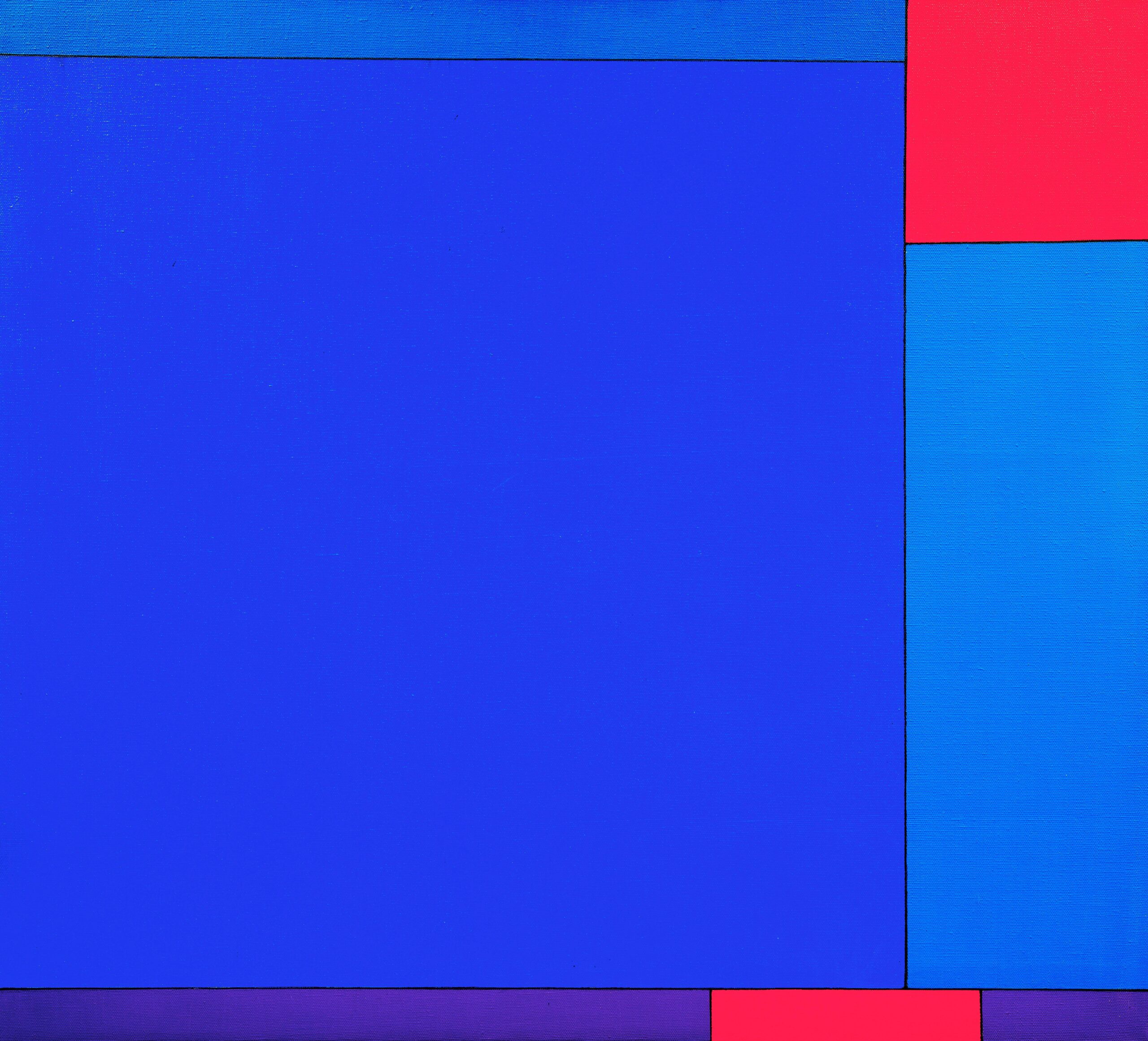
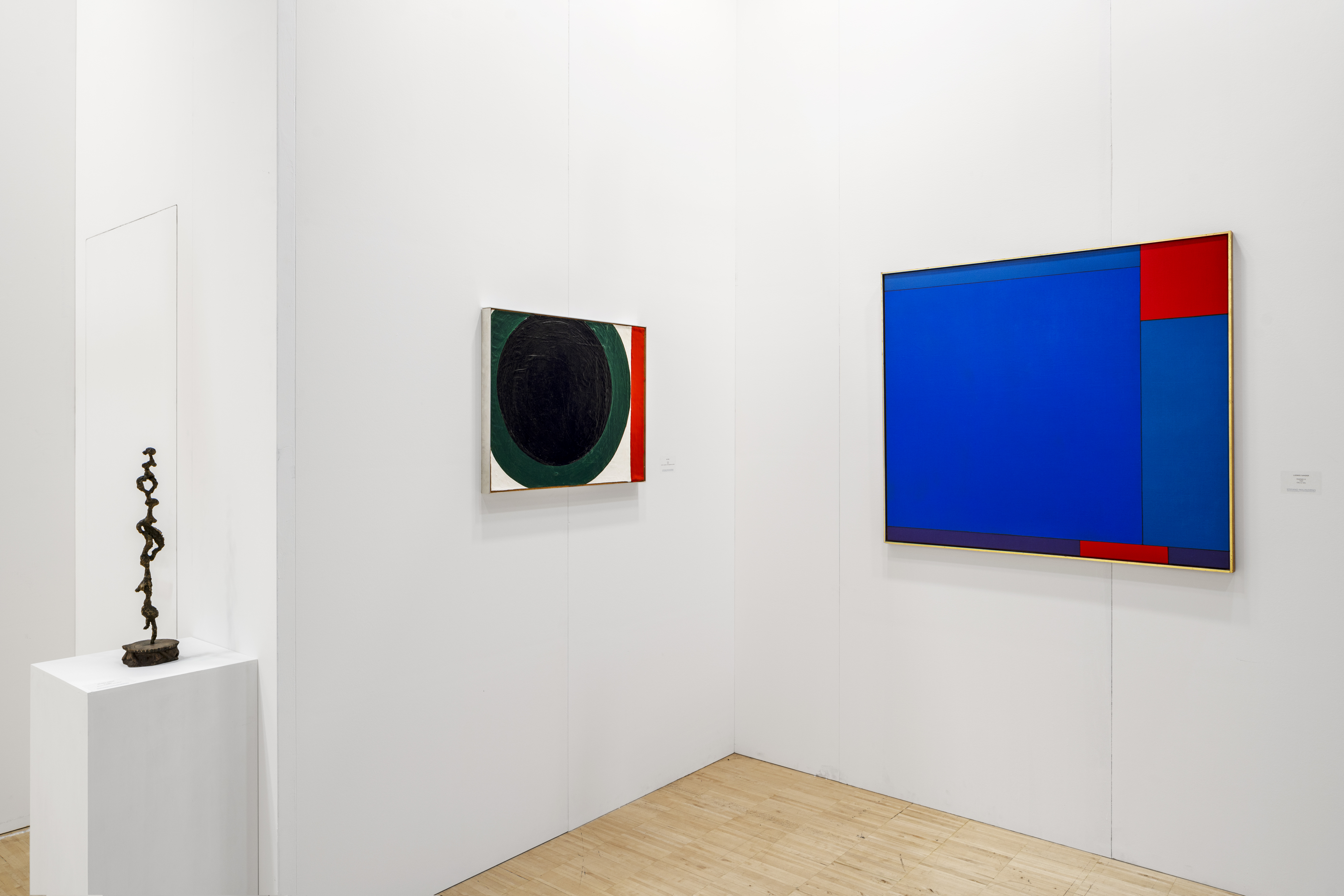
Throughout the 1950s and 1960s, Sander deliberately detached himself from fashionable movements, rejecting both rigid geometric dogmatism and dramatic painterly gesture. Although critics often classified his mature paintings as geometric or Hard-edge abstraction, Sander viewed his rectangular color fields as “ageometric”—developed purely by eye rather than mathematical formulas.
For Sander, each painting was an exploration of minute variations in line thickness, color resonance, and edge ambiguity. He preferred working in traditional oils over synthetic acrylics, carefully adjusting fields of primary and secondary colors until a precise, non-verbal spatial balance was achieved. His sensitivity to color interaction was so acute that in his major gallery exhibitions—such as those at the Kootz, Egan, and Sachs galleries—he insisted on hanging all-yellow paintings together in a single dedicated room, preventing other vibrant hues from disrupting their delicate tonal harmony. Through this quiet, uncompromising dedication, Ludwig Sander created an enduring body of work defined by architectural clarity and profound visual tranquility.
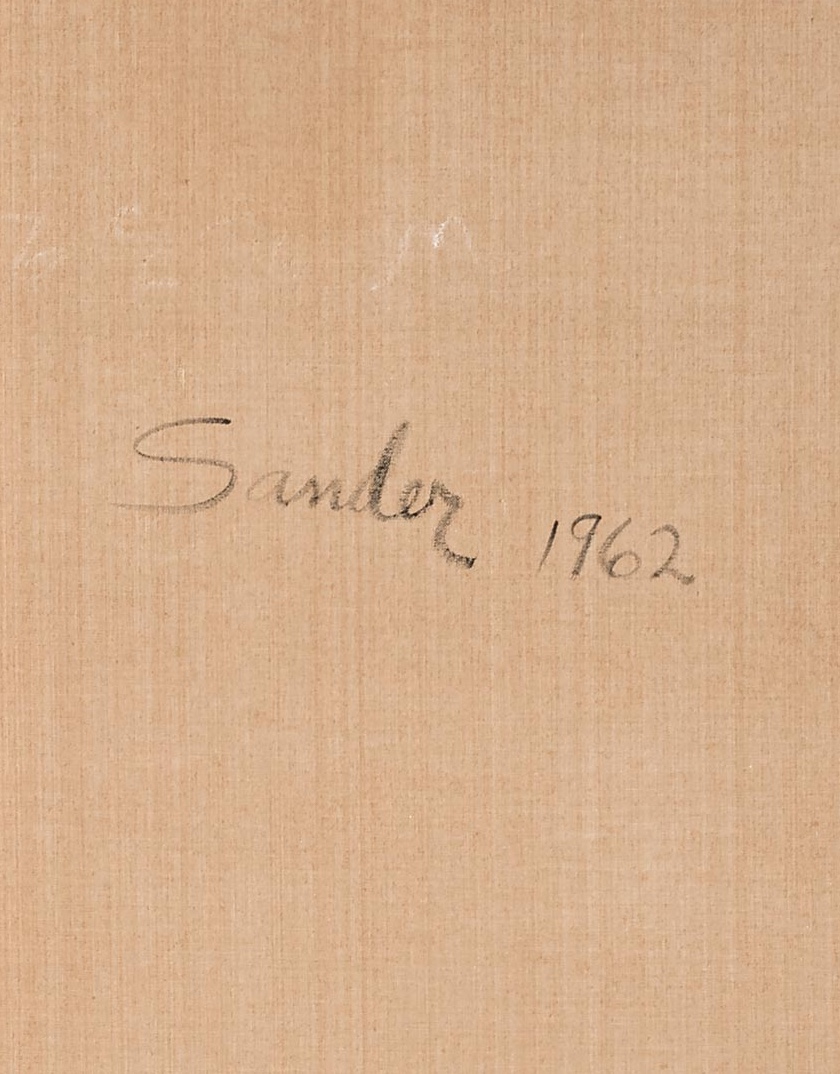
Ludwig Sander’s signature (Untitled, 1962)
BEYOND EXPLANATION: A QUIET LEGACY OF COLOR
In his later years, Ludwig Sander remained entirely uninterested in chasing fleeting art world trends or adopting synthetic acrylics, preferring the living depth of traditional oil paints on a manageable scale. He recognized that he was closer to the end of his journey than the beginning, choosing to focus all his remaining energy on perfecting the subtle color harmonies he had spent decades exploring. For Sander, true artistic excellence lay precisely beyond the point of verbal explanation—where the physical tools dematerialize and only pure visual resonance remains. Believing that art ultimately requires a viewer to exist as more than a private diary, he spent his final years quietly at work in his studio, adjusting hairline divisions and balancing luminous fields of color. In an era often defined by artistic noise and rapid spectacle, Sander’s enduring legacy rests on his serene, disciplined devotion to the silent power of paint.
