
I want to create environments where the viewer’s perception is constantly challenged, where the space itself becomes dynamic and unpredictable.
— Gianni Colombo
I want to create environments where the viewer’s perception is constantly challenged, where the space itself becomes dynamic and unpredictable.
— Gianni Colombo
Biography
Born in Milan in 1937, Gianni Colombo emerged as one of the most visionary figures in Italian art, fundamentally redefining the relationship between the viewer and physical space. His journey into the avant-garde took a decisive turn between 1959 and 1960 when he co-founded the “T Group”, a collective that became a vital link to the international “Nouvelle Tendence” movement. During these early years, he began to move beyond traditional mediums, holding his first solo exhibition at the Galleria Pater in Milan in 1960 and establishing himself as a pioneer of kinetic art and Arte Programmata.
Colombo’s artistic narrative was driven by a fascination with the laws of physics and the hidden aesthetic power of technological rationalism. Rather than using a brush, he sculpted with electrical and magnetic devices, industrial neon lights, and lasers. Throughout the 1960s, he invited the public to experience art through experimental films, kinetic objects, and immersive environments that challenged human perception. His innovative approach reached a global pinnacle in 1968, when he was awarded the grand prize at the Venice Biennial.
In the latter part of his career, Colombo’s influence shifted toward the academic and the architectural. In 1985, he took on the prestigious role of Director of the Brera Academy, where he dedicated himself to teaching the “structuration of space”. His creative hunger never faded, leading him to design avant-garde scenography for the Frankfurt Opera House in 1986 and to explore the realm of virtual architectures. Before his death in 1993, he continued to push boundaries with projects like the “Architetture cacogoniometriche” and “Spazi curvi,” leaving behind a legacy of art that literally moved and breathed within the space it occupied.
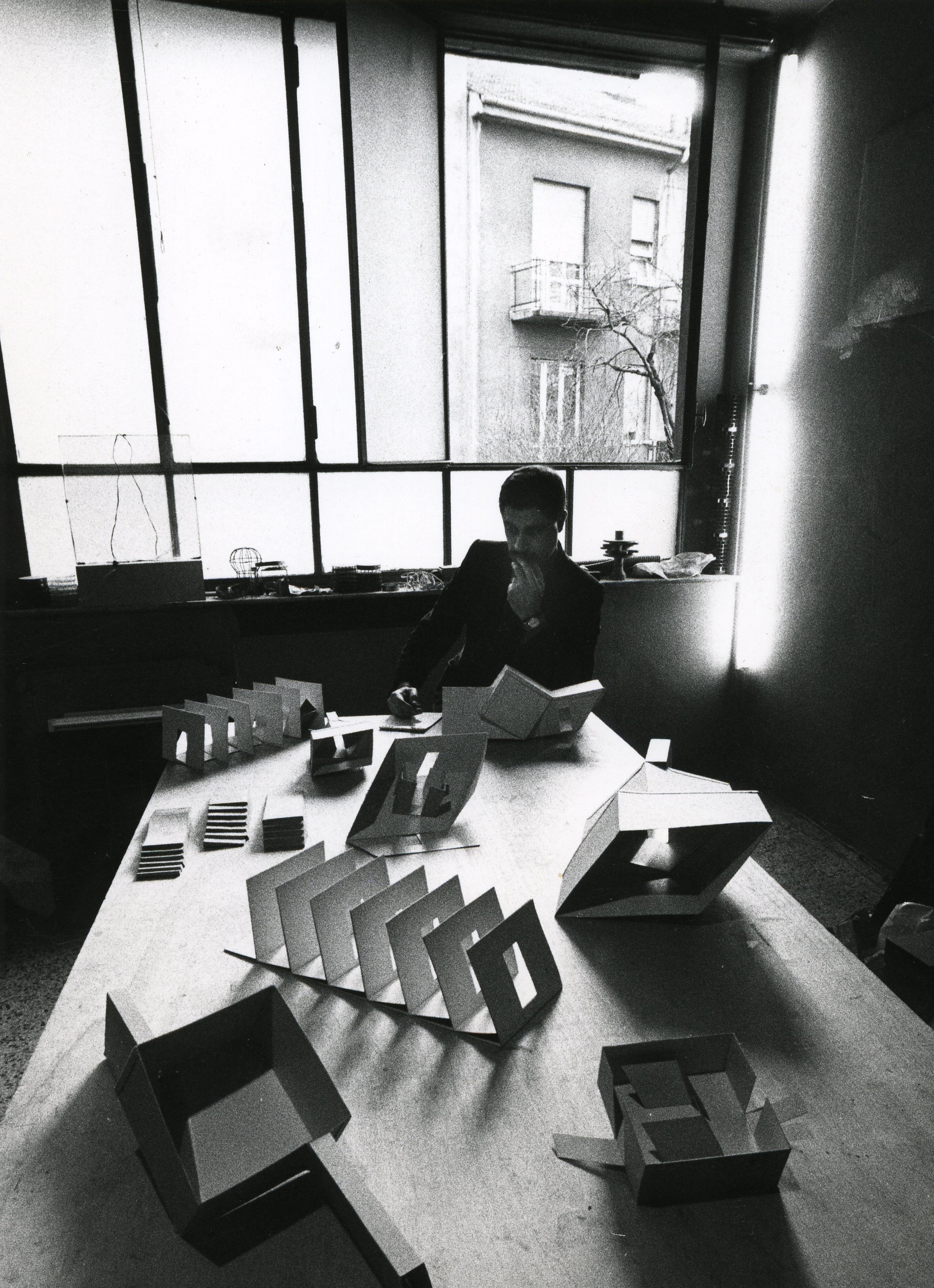
Gianni Colombo in his studio in Milan
