Sculpture is a dialogue with space; it’s about giving form to the invisible, about making the intangible tangible.
— Mirko Basaldella
Sculpture is a dialogue with space; it’s about giving form to the invisible, about making the intangible tangible.
— Mirko Basaldella
Biography
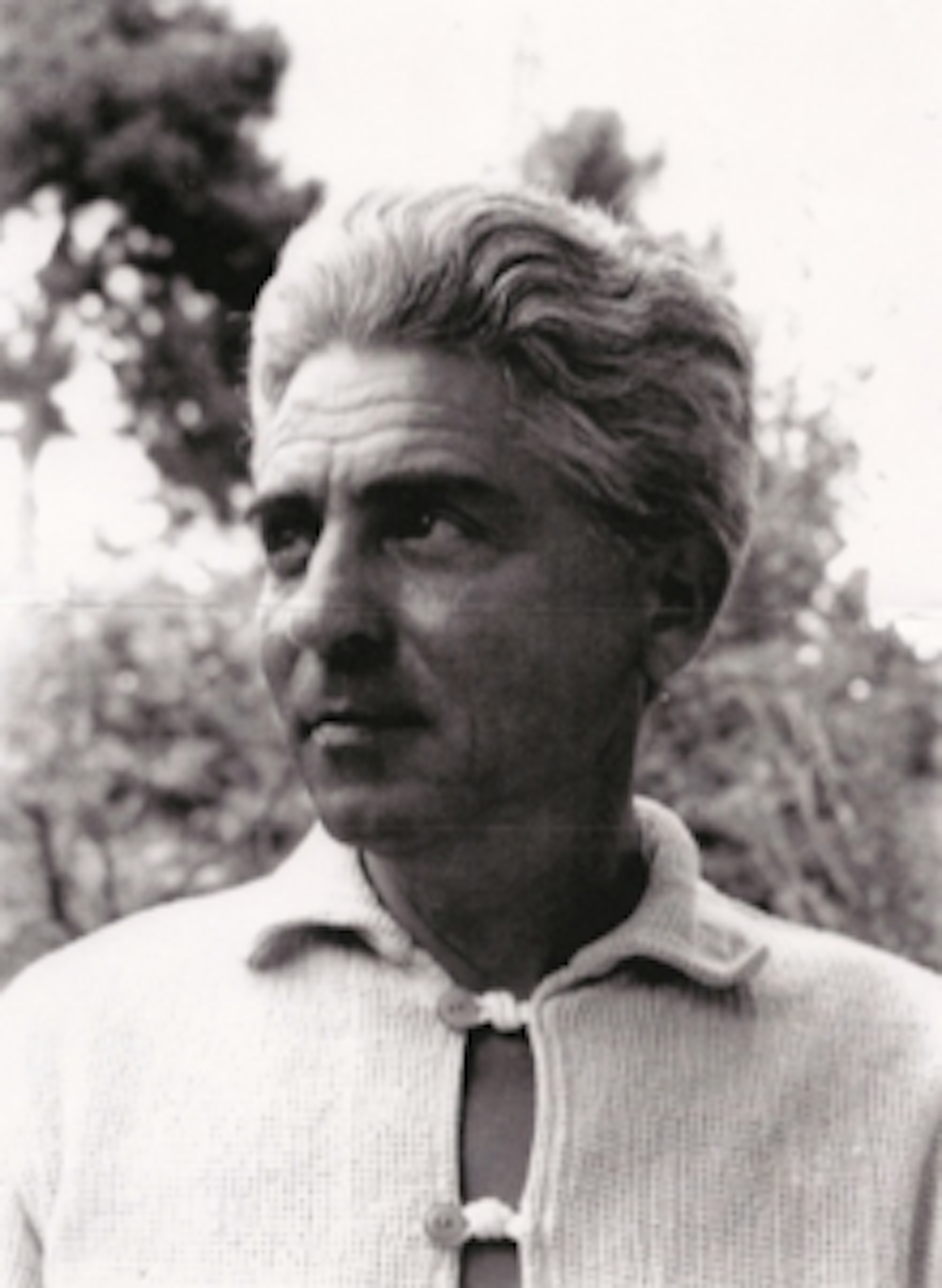
The Italian sculptor and painter, Mirko Basaldella, was born in Udine on September 28, 1910, and concluded his life in Cambridge on November 24, 1969. He belonged to a highly artistic family, being the brother of both Afro and Dino Basaldella. His rigorous early artistic education included attendance at the Art School of Venice, the Academy of Florence, and the School of Art in Monza. Crucially, Basaldella spent his formative years as a student working within the studio of Arturo Martini until 1933, before making the significant move to Rome.
Upon arriving in the capital, Basaldella immediately became integrated into the creative ferment of the Roman School, forming relationships with prominent artists such as Scipione, Antonietta Raphaël, Fazzini, Mazzacurati, Leoncillo, and Corrado Cagli. His connection to this circle was cemented when he married Serena, Corrado Cagli’s sister. Early recognition of his talent came in 1935 with his first exhibition held at the Galleria La Cometa, a location owned by Countess Mimì Pecci Blunt and artistically overseen by Libero de Libero and a young Corrado Cagli. Having settled permanently in Rome in 1935, he also formally joined the Milanese Corrente group. A transformative event occurred in 1937: a journey to Paris undertaken with his brother Afro. This trip broadened Basaldella’s aesthetic perspective, liberating him from the confines of purely Mediterranean culture and enabling him to fully absorb wider European influences.
Basaldella’s reputation soon reached across the Atlantic; he held an exhibition at the Knoedler gallery in New York in 1947, which he was invited to repeat during the subsequent two years. A turning point in his sculptural career was the commission to create the three bronze gates for the Fosse Ardeatine, a demanding and imposing task he completed between 1949 and 1951. This monumental undertaking pushed him into a new phase of artistic inquiry, compelling him to search for innovative methods of sculpture-making and utilizing materials beyond the traditional repertoire. He began to incorporate elements like concrete, metal mesh, iron wire, and various plastic materials into his structures.
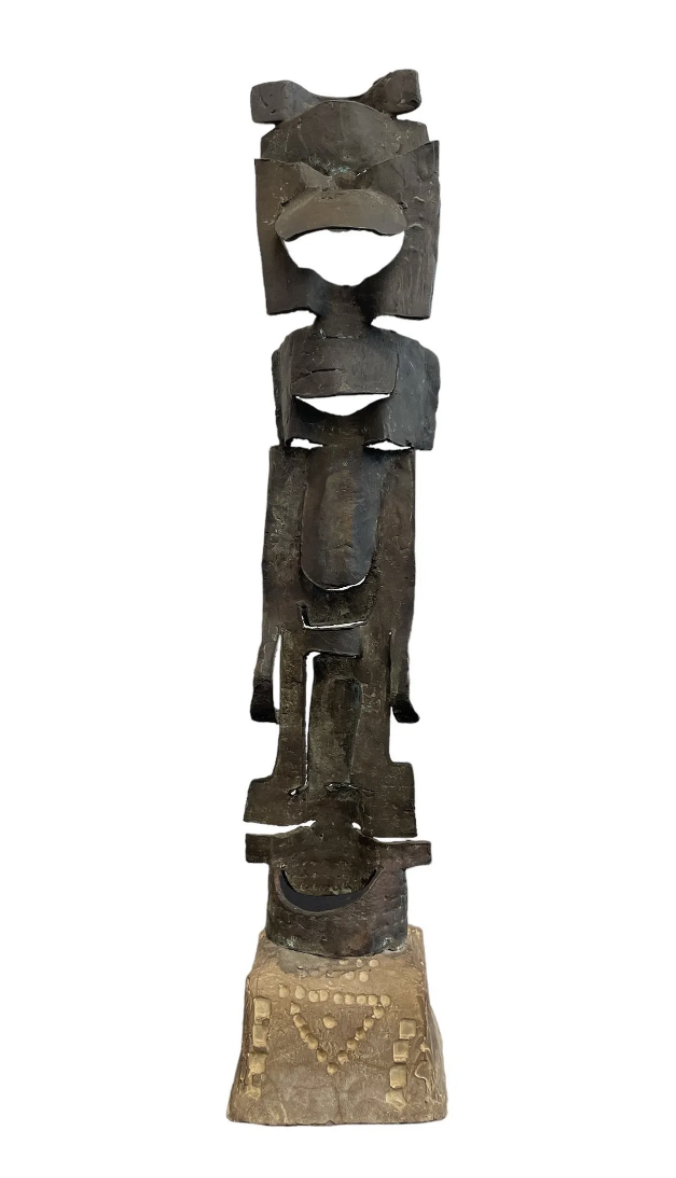
In 1962, Basaldella solidified his position among the world’s leading sculptors by participating in the Sculptures in the City exhibition. Organized by Giovanni Carandente as part of the V Festival dei Due Mondi in Spoleto, he presented two 1961 bronze pieces: Totem and Toothed Pattern. During the latter half of the sixties, his focus turned toward a new series of painted wooden works. His final creations, including small bronzes and bronzes, demonstrate the incredible versatility of the sculptor, showcasing his ability to shape practically any kind of material, from bricks and waste items to the remnants of industrial packaging. Significantly, his long career came full circle as openly figurative themes, drawing inspiration from the biblical subjects of his 1930s work, reappeared, imbued with sophisticated cultural memories.
Basaldella’s artistic journey can be viewed as an evolution from adherence to classic Italian technique to a relentless pursuit of modernity and global synthesis. He was not merely an artist working with materials, but a transformer, treating industrial waste and ancient myths with equal reverence, sculpting a bridge between history and technology.