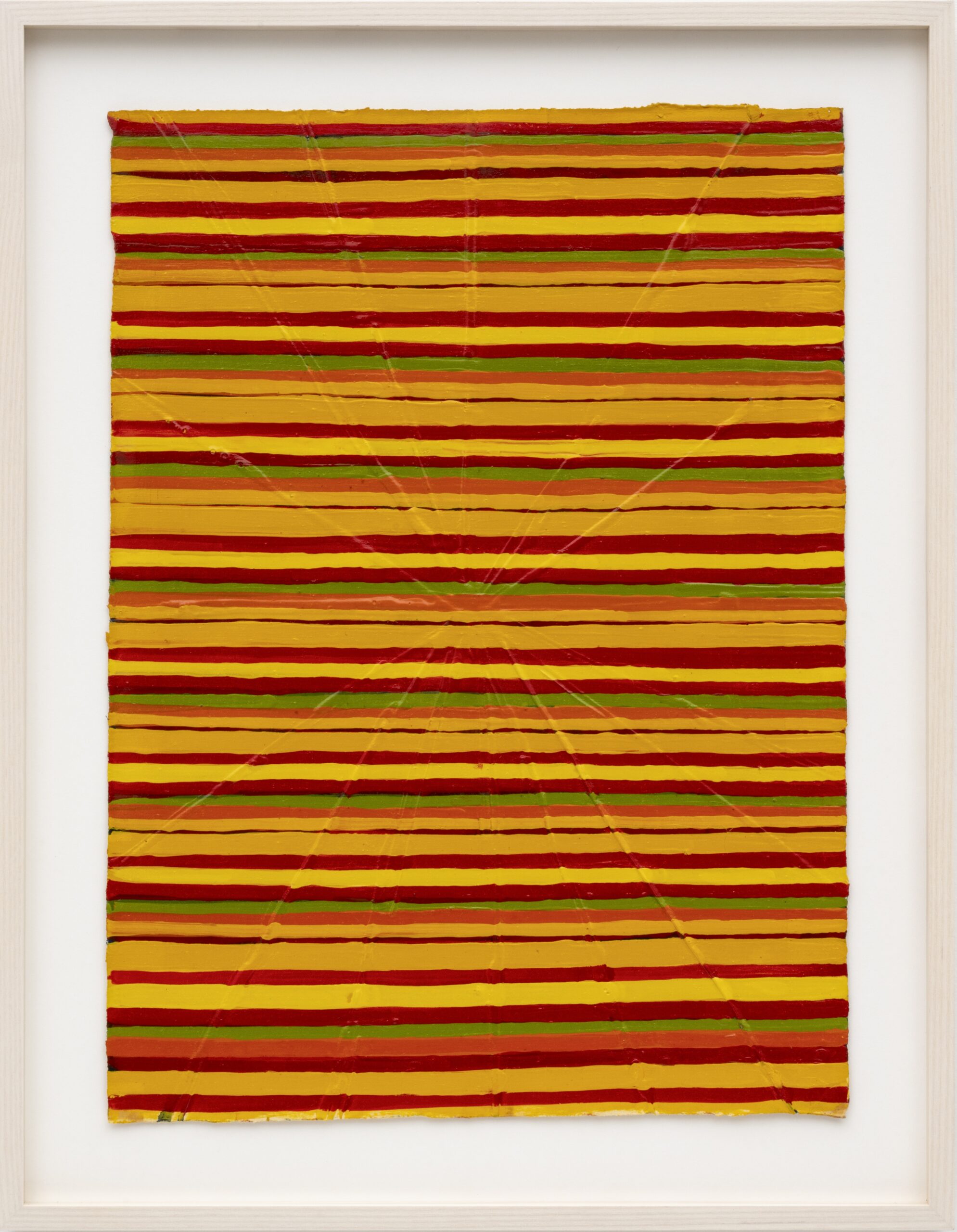
The stripes in the paintings… can be understood as metaphors for space.
– Kunio Motoe
The stripes in the paintings… can be understood as metaphors for space.
– Kunio Motoe
Biography
Masaaki Yamada was born in Tokyo in 1929 and became a prominent figure in the landscape of postwar Japanese art, creating an extensive body of approximately 5,000 works over half a century. He received his education at the Tokyo Prefectural Technical College and began his professional journey by participating in the 1st Japan Independent Exhibition in 1949. By 1950, he joined the Free Artists Association and later deepened his practice by studying under the painter Saburo Hasegawa beginning in 1953.
His artistic career is defined by three distinct stylistic periods, the first of which was the “Still Life” series spanning from 1948 to 1955. Influenced by the trauma of surviving three firebombing air raids and the profound sense of emptiness following Japan’s defeat in the war, Yamada painted objects such as bottles and fruit from memory. Over time, he disassembled and abstracted these subjects, eliminating reproducible elements to achieve a sense of planar flatness and compositional unity.
In 1956, Yamada transitioned into his “Work” series, a project that lasted forty years and is considered the essential core of his artistic output. While early examples of this series utilized an intricate arabesque style, his work shifted around 1958 toward geometric compositions involving stripes, crosses, and grids. These paintings were not a move toward Minimalism but rather an exploration of concepts such as “totality” and the “equivalence of colors,” which he meticulously documented in 56 volumes of production notes comprising 2,000 pages. During this era, he adopted a systematic titling method where alphabetical letters represented the decade of production, such as “Work B” for the 1950s and “Work C” for the 1960s.