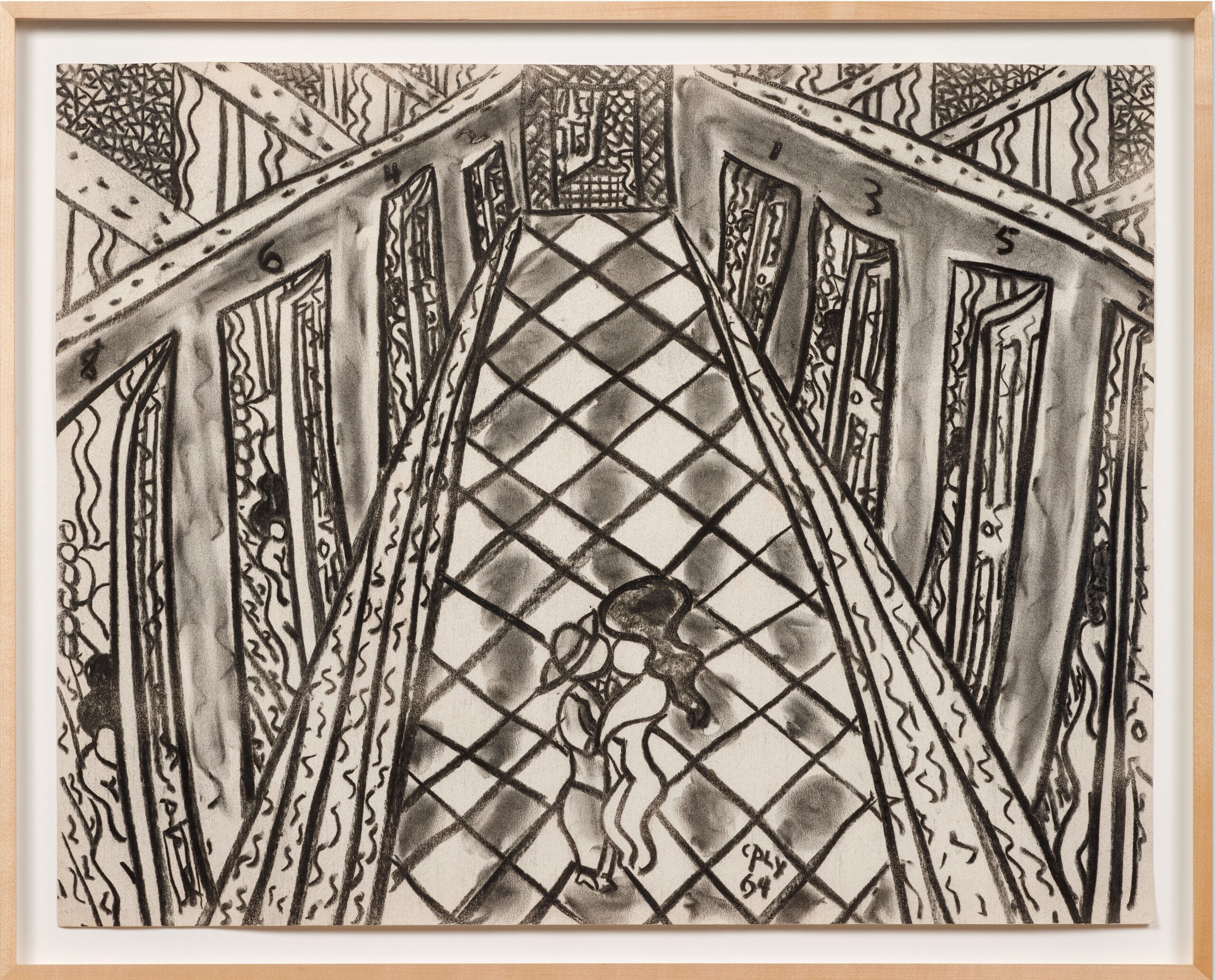
If you have a drawing and the drawing isn’t perfect you have a perfect drawing. If you start a painting, the painting will not be perfect until it is perfect.
— William N. Copley
If you have a drawing and the drawing isn’t perfect you have a perfect drawing. If you start a painting, the painting will not be perfect until it is perfect.
— William N. Copley
Biography
William Nelson Copley (b. 1919, New York, N.Y.; d. 1996, Sugarloaf Key, Fla.) was a prominent American artist whose career spanned from the postwar era to the late 20th century. Renowned for his groundbreaking work, Copley explored themes of humor, eroticism, and social critique with bold originality.
Primarily a painter, Copley proudly identified as self-taught. His distinctive figurative style—playfully unconventional and often subversive—served as a vehicle for examining provocative subjects such as sexuality, politics, and personal identity, which he revisited throughout his career.
He characterized his style as intrinsically linked to a process of self-discovery. This personal and introspective approach informed a diverse body of work that extended beyond painting.
Copley began experimenting with painting in his late twenties, around 1946–47, following several years of artistic exploration. During this early phase, he was supported and encouraged by key figures of the avant-garde—Max Ernst, Man Ray, and Marcel Duchamp—whom he had come to know through his involvement in the art world as a gallerist. Without the benefit of formal artistic education, he deliberately adopted a raw, unrefined visual language, believing its immediacy allowed for stronger expressive impact. He eventually abbreviated his surname—removing the vowels—to create the signature “CPLY,” which became a consistent and recognizable element of his artistic identity.
Copley often nodded to the artists he admired—such as Duchamp, Magritte, and Picabia—whether through homage, satire, or reinterpretation. His close friendship with Duchamp, in particular, played a formative role in shaping his artistic outlook.
He debuted his work in 1951 with a show at a Los Angeles bookstore, then relocated to France, where he lived and worked until 1962. Based first in Paris and later in Longpont-sur-Orge, he maintained a studio at the renowned Impasse Ronsin and held his first European solo exhibition at Galerie Nina Dausset in 1953.
Returning to the U.S. in the early 1960s, Copley divided his time between New York, Connecticut, and the Florida Keys.
Copley consistently challenged dominant art trends, favoring narrative, humor, and personal symbolism at a time when Abstract Expressionism held sway. His work also anticipated shifts toward Pop Art and later figurative revivals in the 1980s and beyond.
Parallel to his art-making, Copley played a pivotal role as a collector, supporter, and publisher. In 1954, he and his wife Noma established the William and Noma Copley Foundation (later the Cassandra Foundation), offering grants in art and music, publishing monographs, and securing major works—like Duchamp’s Étant donnés—for public collections. In 1968, he founded the Letter Edged in Black Press to produce S.M.S., a six-issue art publication featuring inventive, multimedia editions by a wide range of contemporary artists.
Major exhibitions of Copley’s work have been held at the Stedelijk Museum, Amsterdam (1966); Kunsthalle Bern, Bern, Switzerland (traveling) (1980–81); Kestner-Gesselschaft, Hannover, Germany (1995); Ulmer Museum, Ulm, Germany (1997); Frieder Burda Museum, Baden-Baden, Germany (2012); The Menil Collection, Houston, Texas, and Fondazione Prada, Milan (both 2016). His work was included in documenta 5 (1972) and documenta 7 (1981), Kassel, Germany, as well as other important group exhibitions: Pop Art USA, Oakland Art Museum, Oakland, California, (1963); “Bad” Painting, The New Museum, New York (1978); Westkunst, Museen der Stadt, Cologne (1981). Copley has been the subject of recent exhibitions at ICA Miami, Miami, Fla. (2018–19) and Philara Collection, Düsseldorf (2023–24). His work is held in public collections including the Museum of Modern Art, New York; Whitney Museum of American Art, New York; Tate, London; Ludwig Museum, Cologne; and many other institutions.