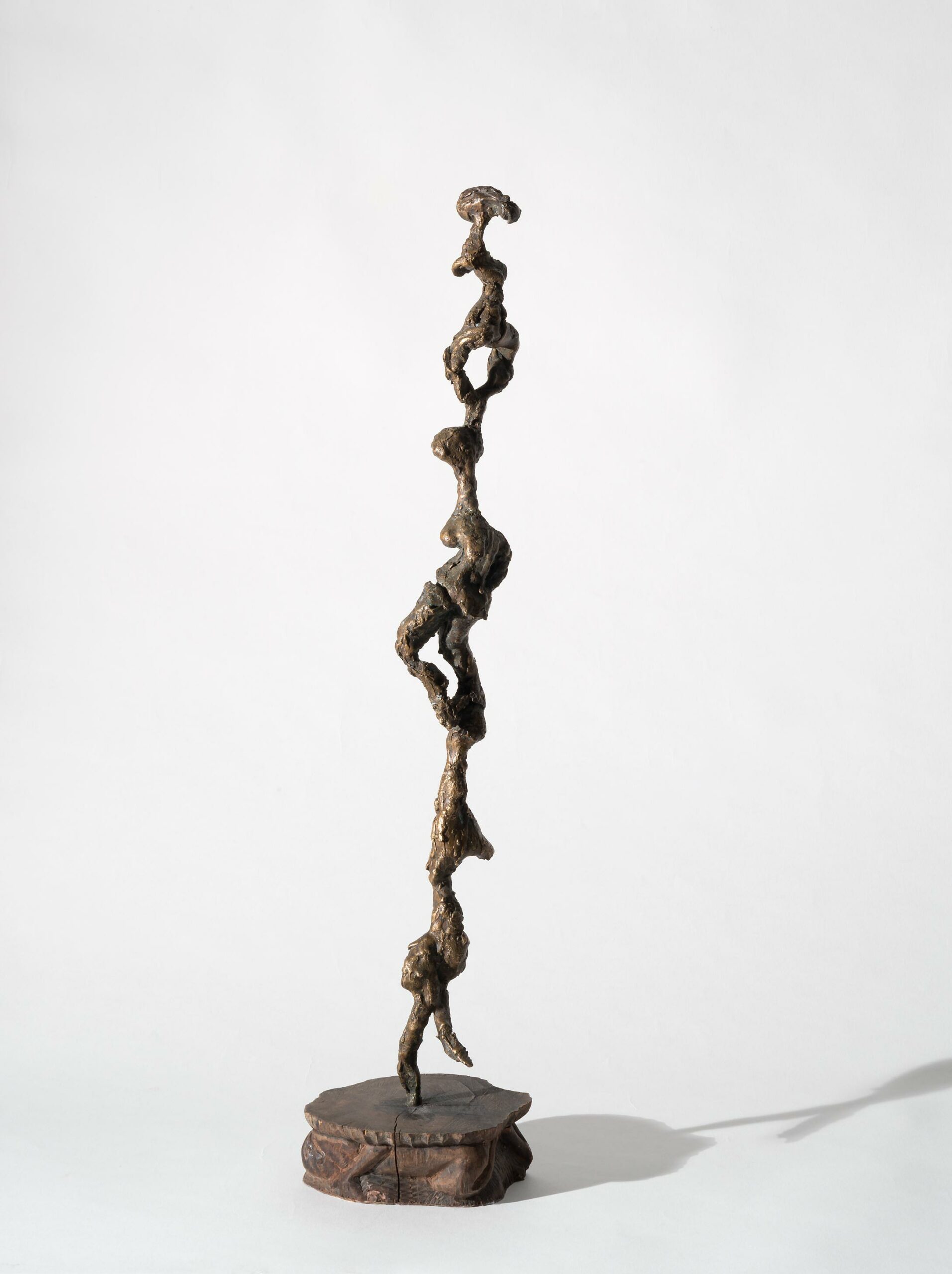
I am interested in making things that evoke the sense of their own history, of having grown from the land.
— Beverly Pepper
I am interested in making things that evoke the sense of their own history, of having grown from the land.
— Beverly Pepper
Biography
Beverly Pepper, born in Brooklyn in 1922, initially trained as a painter, studying with Fernand Leger and André Lhote in Paris. Her early studies also included advertising design, photography, and industrial design at institutions such as the Art Students League and the Académie de la Grande Chaumière in Paris (1940). During a trip to Europe, she visited Rome, where she met the journalist and writer Curtis Bill Pepper, who would become her husband.
Her first solo exhibition, presented by Carlo Levi, was held in Rome at the Galleria dello Zodiaco in 1952. During this time, she fostered connections with the Roman cultural environment, engaging with artists from the Forma1 Group, including Giulio Turcato and Pietro Consagra. After visiting Angkor Wat in Cambodia in 1960, Pepper radically shifted her artistic focus, transitioning to sculpture and creating initial works in wood and clay.
Pepper’s debut as a sculptor occurred in 1961 with exhibitions in New York and Rome (at the Galleria Pogliani, featuring a critical presentation by Giulio Carlo Argan). Her commitment to shaping and forging metal was confirmed by her participation in the 1962 landmark exhibition Sculture nella Cittá in Spoleto and her experience creating large-scale works at the Italsider workshops in Piombino. By 1967–1969, she began experimenting with environmental projects and “connective-art,” often utilizing materials like hay, sand, and grass.
In 1971, Pepper was hosted by Rome to exhibit stainless steel sculptures in Piazza Margana. She created her first environmental project, Dallas Land Canal and Hillside, between 1971 and 1975. After attending the 34th Venice Biennale in 1972, she relocated to Todi, Italy, where she established her residence and atelier-factory.
Pepper’s significant contributions to Land Art include Amphisculpture in New Jersey (1974–1976). Her large-scale environmental works are globally located, featuring the Todi Columns in Todi, Palingenesis in Zurich, Sol y Ombra Park in Barcelona, and the Manhattan Sentinels in New York. She also presented an installation at Forte Belvedere in Florence in 1998 and exhibited at Documenta 6 in Kassel in 1977.
Beverly Pepper passed away in Todi, Italy, on February 5, 2020.
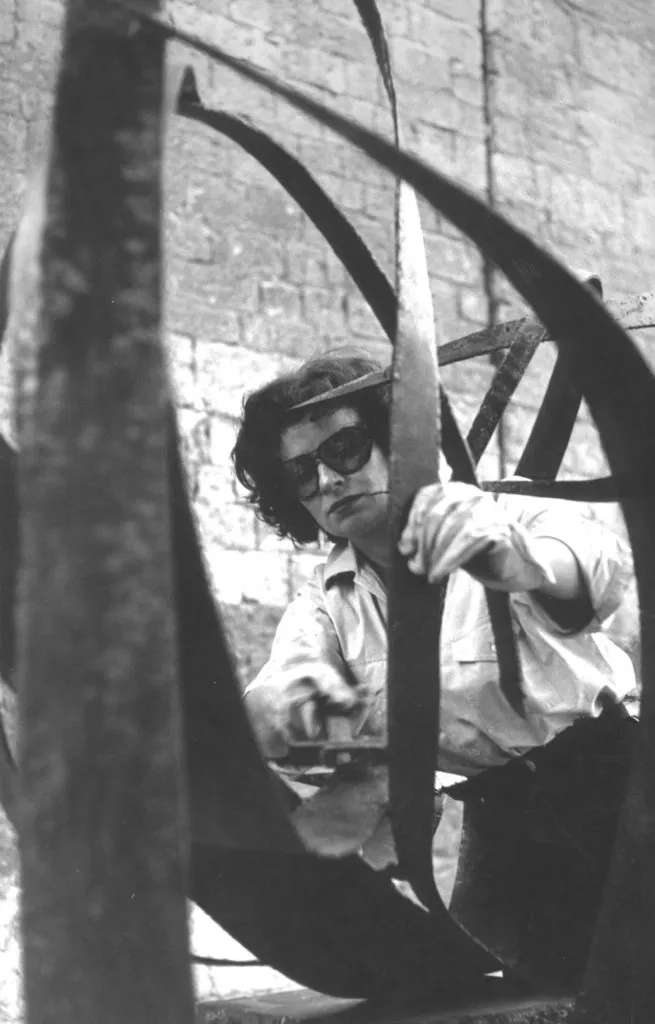
Beverly Pepper in Spoleto, 1962