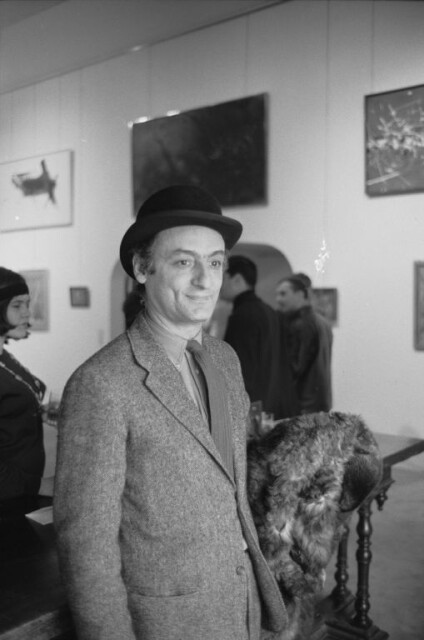
Art and life are not separate; they feed off each other. My work is a reflection of my life, my times, and the culture around me.
— Larry Rivers
Art and life are not separate; they feed off each other. My work is a reflection of my life, my times, and the culture around me.
— Larry Rivers
Biography
Larry Rivers, born Yitzroch Loiz a Grossberg, was a multifaceted and often controversial figure who occupied a central role in the mid-20th-century New York art scene. Originally a jazz saxophonist, Rivers turned to painting after his “natural talent” for drawing was discovered by fellow musician Nell Blaine, who encouraged him to study under the influential Hans Hofmann. Hofmann famously advised Rivers that abstraction was not his path, leading the artist to find his early inspiration in the works of Bonnard and later Soutine.
His career was defined by a constant, often polarizing tension between “linear” and “painterly” expression. Rivers gained significant attention in the 1950s with works that challenged the prevailing dominance of Abstract Expressionism, such as the historical canvas George Washington Crossing the Delaware, which was acquired by the Museum of Modern Art. During this period, he produced what many consider his finest work, including a series of intimate and vulnerable portraits of his mother-in-law, Berdie Berger.
Rivers’ artistic persona was deeply connected to the “Beat” generation, characterized by skepticism, a rejection of middle-class values, and a close-knit circle of literary friends including poets Frank O’Hara and John Ashbery. Despite his technical mastery and “natural talent,” he remained a figure of intense critical debate; while some dismissed his work as “terrible” or “show biz,” others viewed him as an essential barometer of his era.
In his later years, his work became increasingly preoccupied with themes of death, money, and sexuality, often expressed through the use of mundane objects like cigar boxes or playing cards. This shift toward a more “objectified” and sometimes scatological style alienated some critics, yet it reflected Rivers’ own “involuntary truthfulness” and his refusal to adhere to a single, comfortable aesthetic. Ultimately, Rivers remains a unique figure in modernism—a “master craftsman” whose work thrived on the very contradictions that defined his life.